
How Rising Oil Prices Are Accelerating the Digital Transformation of Global Supply Chains and Why RAIN RFID Is the Enabling Technology
 Global oil prices have risen sharply, crossing above $100 per barrel amid significant disruption to energy infrastructure and key shipping corridors. While the duration of elevated prices remains uncertain, the direction is clear: supply chains built around the fuel cost assumptions of recent years are under serious financial pressure, and that pressure may persist for some time.
Rising energy costs are making the price of supply chain inefficiency impossible to ignore. Every unnecessary truck mile, every stock discrepancy, every emergency reorder carries a cost that is increasingly difficult to absorb. For supply chain leaders, this is a pivotal and familiar moment.
When COVID-19 struck in 2020, it revealed overnight which retailers had invested in omnichannel capability and which had not. The retailers who had already built real-time inventory visibility dominated. Those who had not found themselves scrambling to build in weeks what should have been built over years. The capability gap that opened during that crisis never fully closed.
The same dynamic is now unfolding across global supply chains. This is the supply chain efficiency tipping point — the moment when the cost of operating without real-time intelligence exceeds the cost of building it. Businesses that have invested in item-level visibility through RAIN RFID are positioned to respond, adapt, and compete. Those that have not are facing the same reckoning retailers faced in 2020.
Every wasted truck mile, every misplaced pallet, every emergency reorder just became a financial crisis. In a world where the cost of moving things has exploded, the cost of not knowing where things are is no longer tolerable. RAIN RFID eliminates that hidden tax — forever.
The Supply Chain Efficiency Tipping Point
For years, the business case for supply chain digitization has been well understood. Real-time inventory visibility, item-level tracking, and automated data capture all deliver clear, provable ROI. Yet for many businesses, the investment has remained on the roadmap — important but not treated as urgent enough to prioritize.
Elevated oil prices change that calculus entirely. When energy was less expensive, supply chain inefficiency was affordable. At today’s prices, every gap in visibility carries a direct financial cost that lands on the P&L. This is the supply chain efficiency tipping point: the moment when the cost of operating without real-time intelligence exceeds the cost of building it.
Several long-accepted operating norms are now financially untenable:
- Inventory inaccuracy is no longer a rounding error: A 3-5% error rate that was previously manageable now drives unnecessary replenishment orders, emergency shipments, and expedited freight — each one an outsized cost in a high-fuel environment.
- Reactive logistics is too expensive: Managing supply chain exceptions after the fact — rerouting shipments, tracking down misplaced inventory, processing returns manually — carries energy costs that compound quickly. Precision and foresight are now financial imperatives.
- Lean supply chains need real-time intelligence to stay lean: Just-in-time operations have no margin for error when disruptions are frequent and recovery is slow. Businesses need to see their inventory in real time to make confident decisions about when to reorder, reroute, or reallocate.
- Multi-node networks require automated tracking: As businesses diversify suppliers and build out regional distribution networks to reduce concentration risk, the complexity of managing those networks grows. Manual processes cannot scale; automated, item-level visibility can.
A Structural Shift, Not a Temporary One
What makes this tipping point significant is that even if energy prices moderate, the structural forces driving demand for supply chain intelligence will not. Three irreversible trends are permanently raising the standard: 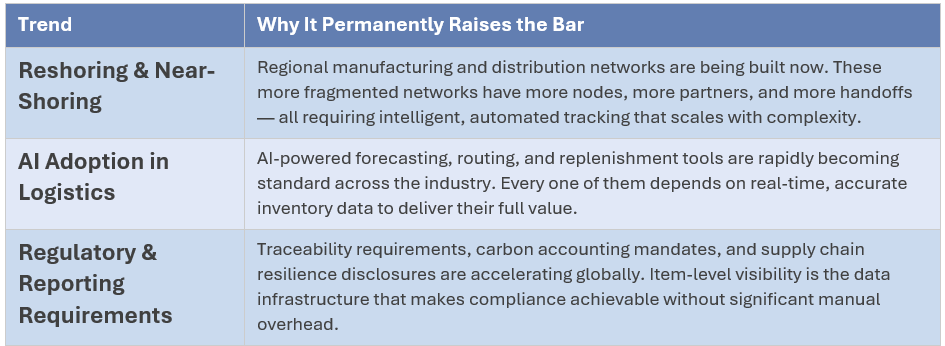
Rising energy prices did not create the need for supply chain intelligence. They made the cost of operating without it impossible to ignore.
Aileen Ryan, CEO & President, RAIN Alliance
RAIN RFID: The Nervous System of the Intelligent Supply Chain
RAIN RFID functions as the nervous system of a modern supply chain — the always-on, item-level sensing layer that captures what is happening across every node in real time and makes that information immediately available to every system and decision that depends on it.
Unlike barcodes, which require deliberate scanning and line-of-sight access, RAIN operates passively and continuously. Tags embedded in items, cases, and pallets are read automatically at every touchpoint — dock doors, warehouse locations, conveyor systems, store floors — without any human action required. The result is a continuous, high-frequency stream of accurate, location-aware inventory data that reflects the physical world as it is right now.
Real-Time Inventory Truth
At the core of every supply chain problem amplified by elevated energy costs is the same root cause: decisions made on incomplete or outdated information. A truck dispatched to replenish stock that was already there. An emergency order placed for inventory sitting in a different warehouse. A shipment rerouted based on a count from last week.
RAIN RFID eliminates that root cause. Real-time, item-level inventory means every location in the network always reflects actual stock — not the last count, not an estimate, not a system record pending reconciliation. When the data is always current, the expensive reactive responses that incorrect data trigger simply don’t happen.
Eliminate Wasted Motion
Every movement in the supply chain has an energy cost. In a high-fuel cost environment, wasted motion — time spent searching for a misplaced pallet, fuel burned on a truck sent to the wrong location, labor spent manually investigating discrepancies — compounds quickly across any network.
When every tagged item can be located in seconds and every movement is captured automatically, that waste disappears. Dock doors read incoming shipments without manual scanning. Inventory positions update in real time as goods move through the facility. Exception reports surface immediately rather than days later when the damage is already done. Fewer movements, fewer errors, and lower energy consumption per unit shipped.
Supply Chain Resilience Through Rapid Reallocation
Resilience in a disrupted supply environment is not about having more inventory, it is about knowing what you have and being able to act on that knowledge immediately. When a supplier is delayed, a shipping lane is affected, or a distribution center is operating below capacity, the businesses that respond fastest are those that know their inventory positions across the entire network in real time.
RAIN-enabled businesses can answer the critical questions — what do we have on hand, where is it, what is in transit, what can we reallocate — in hours rather than days. Supplier accountability at receiving validates that what was ordered actually arrived. Serialized traceability enables fast returns processing and cross-network repositioning. And as regional distribution networks grow more complex, RAIN technology scales across every new node without additional manual overhead.
Automated Data Capture at Speed and Scale
Manual data entry and barcode scanning are not just slow — they are a source of the inaccuracies that make supply chain operations expensive and reactive. At high volume, even small error rates compound into significant operational costs.
RAIN readers process hundreds of tags per second at dock doors and key checkpoints throughout the supply chain, replacing manual receiving and inventory processes with automated, high-accuracy data capture. Receiving accuracy improves. Processing speed increases. Labor requirements decrease. And the data flowing into every downstream system — ERP, WMS, TMS, and AI analytics — is clean, current, and reliable.
The Foundation for AI-Powered Supply Chain Intelligence
RAIN RFID’s role as the supply chain nervous system is what makes AI-powered supply chain management genuinely work. AI tools for demand forecasting, autonomous replenishment, dynamic routing, and risk detection are advancing rapidly — but they are only as accurate as the data feeding them.
Most supply chain AI today operates on inventory data that is days old and partially inaccurate. The result is not uncertain outputs, it is wrong outputs, at scale. RAIN RFID solves this at the foundation. Real-time, item-level, continuously updated physical data is what transforms supply chain AI from a source of misdirection into a genuine operational advantage. Organizations that build the RAIN data foundation now are building the asset that powers every AI advantage they will ever have.
Conclusion
Rising energy prices have brought into sharp focus a reality that supply chain leaders already understood: the cost of operating without real-time inventory visibility is real, growing, and no longer easy to absorb. What was a manageable inefficiency at lower energy costs is now a direct financial impact at every level of operations.
The opportunity in this moment is clear. Businesses that accelerate investment in RAIN RFID now, rather than waiting for conditions to force the decision, will not just reduce the impact of elevated energy costs today. They will emerge with a structural supply chain advantage that compounds over time, in the same way the retailers who invested in RAIN RFID-driven inventory accuracy before COVID emerged from that crisis as the definitive leaders in omnichannel retail.
RAIN RFID is the foundational layer that makes supply chain intelligence possible — the nervous system that gives every other system, process, and AI application a real-time, accurate picture of what is happening across the physical supply chain. With it, every investment in supply chain technology delivers more. Every AI tool performs better. Every decision is made on a stronger foundation.