

Every DPP-ready RAIN tag is built around an integrated circuit. The chip inside the tag is what determines how long it holds its data and how reliably it can be read when it matters most.
What Makes a RAIN Tag DPP-Ready? It Starts with the IC
If you have been following the Digital Product Passport story, you will know that the EU’s ESPR regulation requires every garment sold in the EU to carry a permanent, machine-readable tag: one that survives washing, ironing, years of consumer use, and is still readable when the garment reaches a recycling facility or second-hand platform at the end of its life.
The conversation about which tags meet that requirement — sewn-in labels, laundry-rated labels, embedded tags — is well underway. RAIN Alliance member companies are already supplying products across all three form factors with a growing catalogue of options.
Every DPP-ready RAIN tag is built around an integrated circuit (IC). The IC carries the unique identifier that links the physical product to its Digital Product Passport, and determines how long that identifier is retained and how reliably it can be read across the product’s lifetime. The capability of the finished tag begins with the capability of the chip inside it.
What the DPP Requirement Means for the IC
Most RAIN RFID tags in use today are not designed for lifetime applications. They are optimised for supply chain tracking; durable enough to survive a warehouse, a shipping container, and a retail environment, but not necessarily a garment that will be washed two hundred times and then sorted at a recycling facility a decade from now.
All RAIN ICs provide a factory-programmed, globally unique Tag Identifier — the TID — that cannot be duplicated or overwritten. The specifications that genuinely vary between ICs, and that matter most for lifetime textile DPP applications, are data retention and sensitivity.
Data Retention
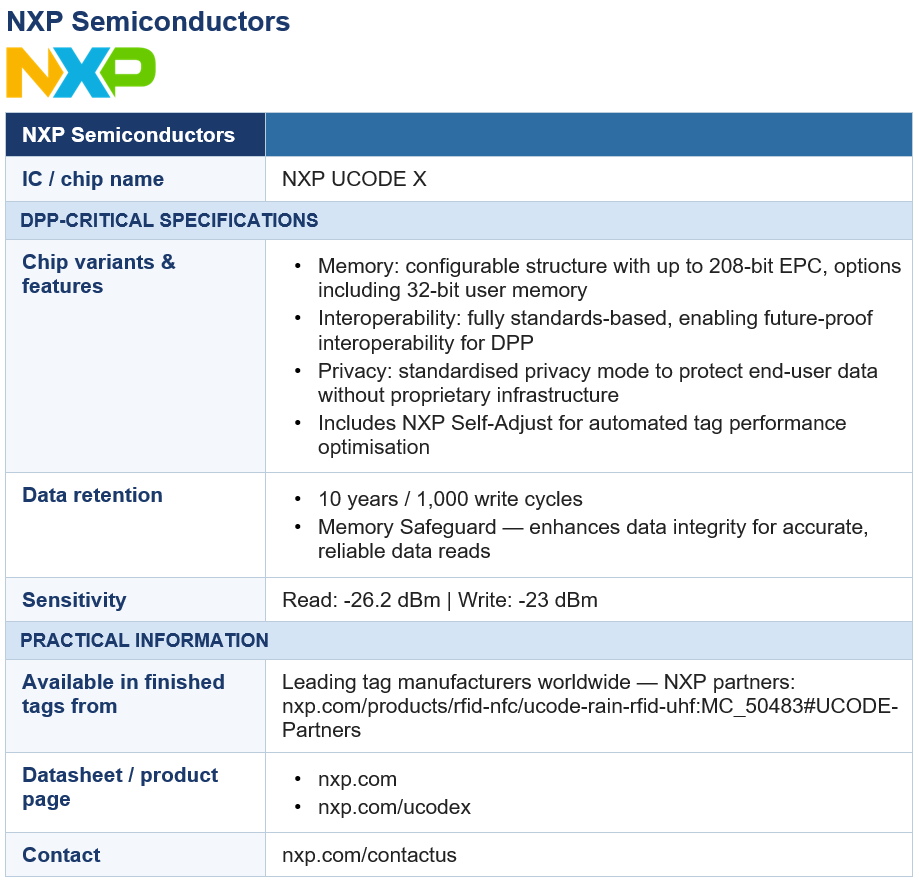
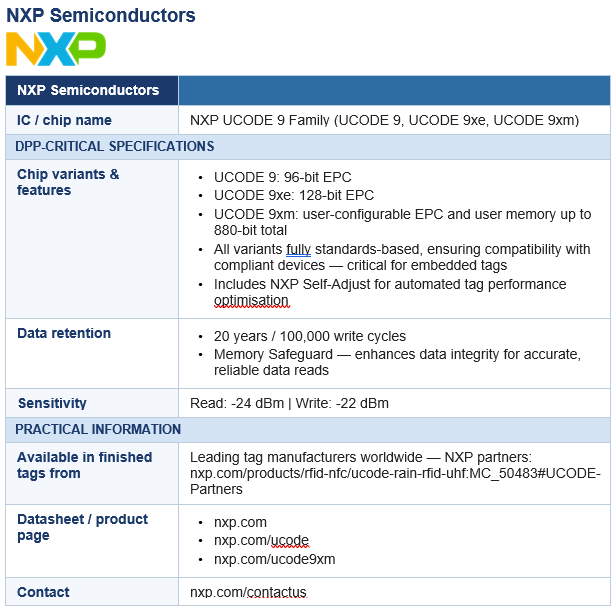
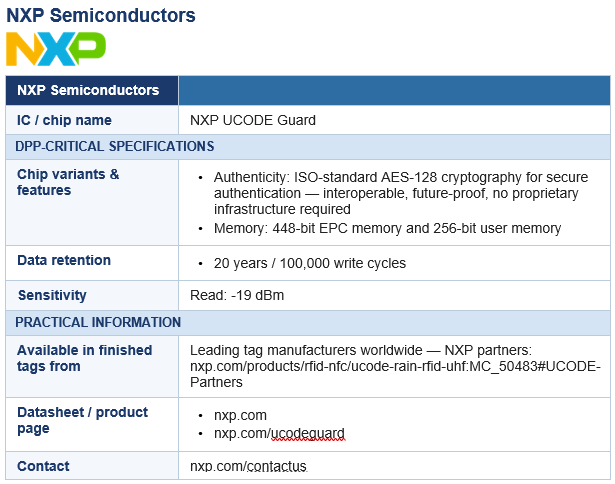
A DPP-compliant garment tag must hold its data reliably for the lifetime of the product; potentially 10 years or more, through repeated washing, temperature extremes, and physical stress. That is a fundamentally different requirement from a pallet tag, which only needs to survive from factory to store. Not all RAIN ICs are rated to the same data retention standard, and the difference between a chip rated for five years and one rated for fifty years is the difference between a tag that serves its DPP purpose and one that quietly fails mid-lifecycle.
Sensitivity and End-of-Life Readability
The sensitivity of an IC, measured in dBm, determines how little power is needed to activate the tag. A more sensitive chip can be read at greater distance, through more challenging materials, and with lower-powered readers. For a tag that will be read at a sorting facility years after manufacture — directing garments toward second-hand markets or the recycling stream — potentially by equipment that cannot be positioned optimally, sensitivity is a meaningful differentiator that supply chain tags are rarely selected for.
RAIN Alliance IC Manufacturers: DPP-Ready Chips for Textile Applications
The RAIN Alliance member products featured here are at the heart of DPP-ready RAIN tags. Each entry focuses on the specifications most directly relevant to lifetime textile DPP applications — data retention and sensitivity.
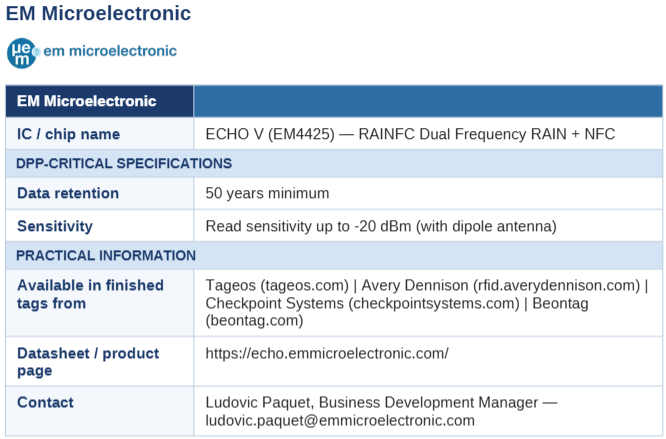
EM Microelectronic
EM Microelectronic, part of the Swatch Group, is a specialist in ultra-low-power semiconductors with a strong RAIN RFID IC portfolio.
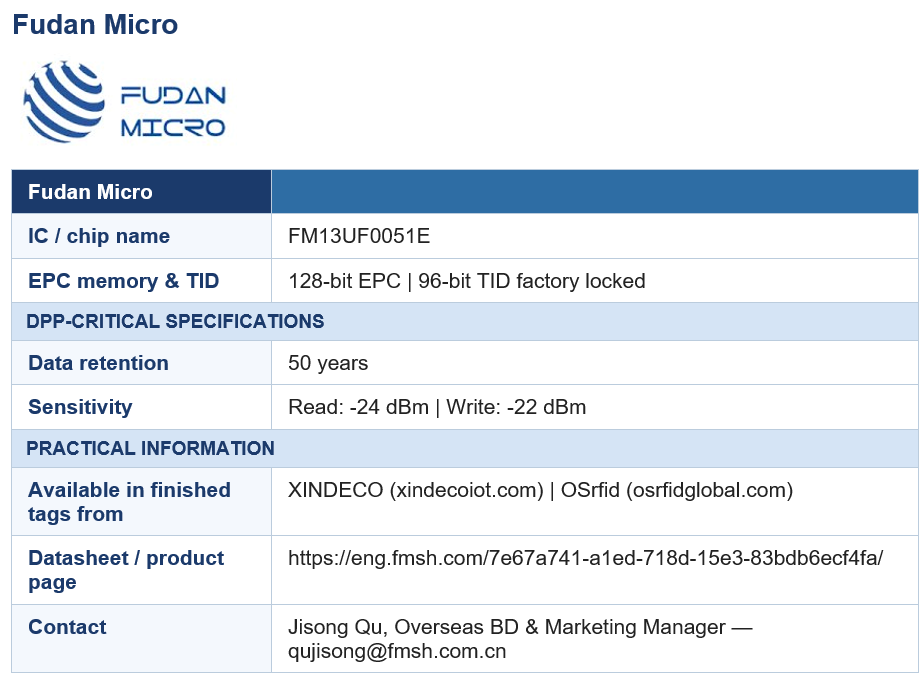
Fudan Micro
Fudan Micro is a leading semiconductor manufacturer with a growing RAIN RFID IC portfolio.

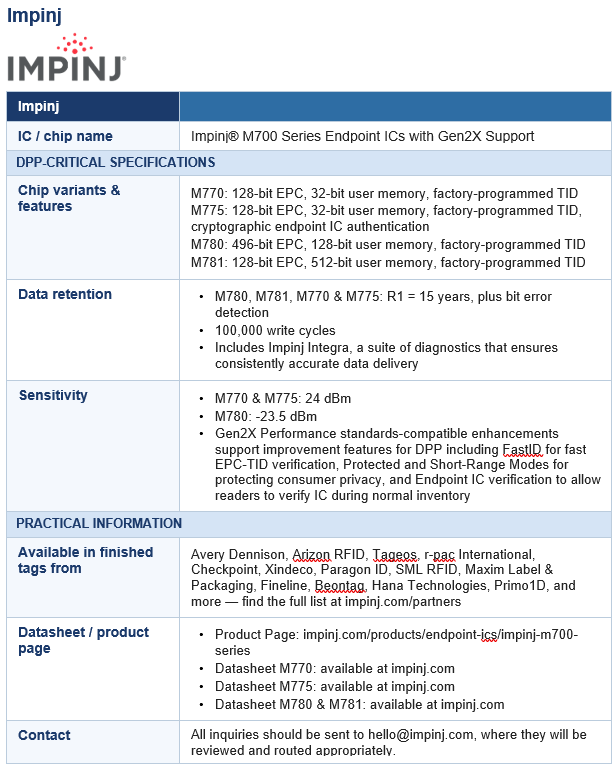
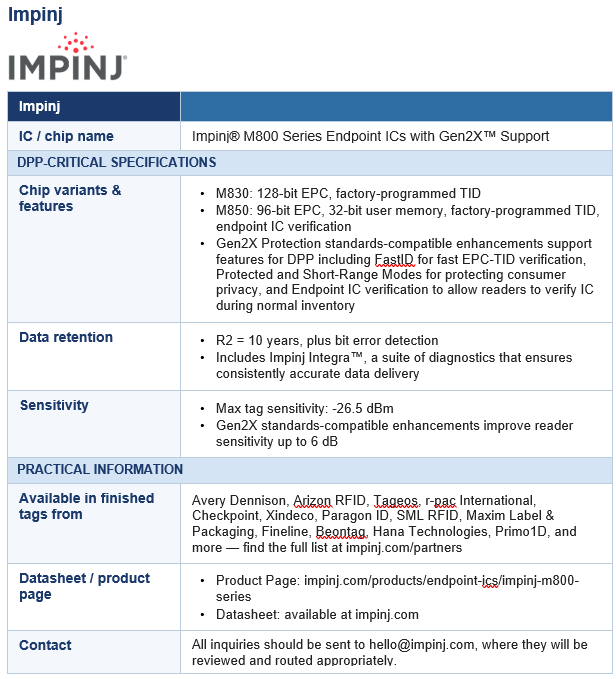
Impinj
Impinj is a leading provider of RAIN RFID products and solutions that help businesses wirelessly connect billions of everyday things.
NXP
NXP, a global semiconductor leader, powers standards-based, future-proof item intelligence at scale with UCODE RAIN RFID.
Specifying the Right IC for Your DPP Application
The IC landscape for RAIN RFID is mature, standards-based, and built around open specifications. Any chip from the manufacturers listed here will be compatible with the global RAIN RFID infrastructure already deployed across the retail and apparel sector. The differences between them are ones of degree — sensitivity, data retention ceiling, security capability — that matter most when the application demands lifetime performance.
The practical guidance is straightforward: use the RAIN Alliance textile tag guide to identify finished inlay products that meet the durability and quality grade requirements for your application, and ask those inlay manufacturers which IC their product is built around. The IC specification will confirm whether the finished tag can deliver on lifetime data carrier requirements.
To explore finished tag solutions built around these ICs, visit the RAIN Alliance textile DPP tag guide.