
 This is the third in a series of guides exploring how RAIN RFID technology enables Digital Product Passport compliance across regulated product categories. Part 1 covers textile tags | Part 2 covers RAIN RFID integrated circuits.
Every tyre sold in the EU will soon require a Digital Product Passport. The data carrier that carries it must survive vulcanisation, years of road use, and still be readable at the end of the tyre’s life. In May 2026, the European Commission’s official preparatory study on tyres proposed RAIN RFID as the primary data carrier for the tyre DPP. The technology is already deployed at scale. The regulatory direction is now clear.
The DPP Requirement is Coming for Tyres and the Direction Is Clear
In May 2026, the European Commission’s official ESPR preparatory study on tyres proposed RAIN RFID as the primary data carrier for the tyre Digital Product Passport. The delegated act that will formally define those requirements is expected in 2027, with mandatory compliance following 18–36 months later. For tyre manufacturers and their suppliers, the question is no longer which technology to adopt — it is how quickly to move.
That recommendation reflects years of industry deployment and a mature technical standards framework. JTC24 has codified RAIN RFID as a permitted DPP data carrier. ISO 20909:2019 defines three form factors for RFID tyre tag applications — embedded, patch, and sticker (label). For DPP applications, where the data carrier must remain with the tyre for its entire lifetime, embedded and patch tags are the most appropriate options. Sticker labels, while widely used for supply chain and retail tracking, require careful evaluation for lifetime DPP use. And major manufacturers including Michelin have already embedded RAIN RFID in tens of millions of tyres in production.
Why Tyres Present a Uniquely Demanding Tag Requirement
A tyre DPP tag faces a set of physical challenges that have no equivalent in any other regulated product category. Understanding those challenges is essential to understanding why not all RAIN tags are suitable — and why those that do represent a significant engineering achievement.
Lifetime Mechanical and Environmental Stress
Once on the road, a tyre tag must withstand continuous mechanical stress — flexing, vibration, and impact — across the full operational life of the tyre, potentially covering hundreds of thousands of kilometres over many years. It must also function across a wide operating temperature range, from sub-zero winter conditions to the heat generated by sustained high-speed driving.
Reading Through Rubber
Unlike a textile tag read in open air, a tyre tag embedded in rubber must be readable through the tyre material itself. The rubber composition, tyre thickness, and internal metal components all affect read performance. Tag antenna design must account for these variables to ensure reliable readability throughout the tyre’s life — including at end-of-life sorting facilities where the tag will need to be read quickly and accurately.
ISO 20909:2019 RAIN RFID Attachment Methods for Tyres
ISO 20909:2019 identifies three RFID tyre tag attachment methods. For DPP applications requiring a lifetime data carrier, embedded and patch tags are the primary options. Sticker labels are also covered here for completeness, though their suitability for lifetime DPP use requires careful evaluation on a case-by-case basis.
Embedded Tags
The most permanent and tamper-proof option. The RAIN RFID tag is integrated into the rubber layers of the tyre during the manufacturing process, typically placed horizontally within the sidewall or bead area to minimise the impact of road stress on the tag structure. Embedded tags survive vulcanisation and cannot be removed without destroying the tyre. They represent the gold standard for lifetime DPP applications and are the form factor already deployed at scale by major manufacturers.
Patch Tags
A flexible RAIN RFID tag bonded to the inner surface of the tyre after vulcanisation, making them accessible to manufacturers who cannot modify their existing production line. Their DPP suitability depends on the engineering quality and durability of the specific product — the member directory below indicates which products have been validated for lifetime tyre applications.
Sticker labels
RAIN RFID sticker labels for tires are temporary identification labels applied to the tread surface of a tire to facilitate tracking and management throughout manufacturing, distribution, warehousing, retail, and other supply chain operations. RAIN RFID tread labels are intended for temporary use during the pre-service phase of a tire’s lifecycle and are removed before the tire enters service. Consequently, they are not suitable as a carrier for DPP applications where an identifier must remain associated with the tire throughout its operational life.
Other RAIN RFID Attachment Methods for Tyres
Vulcanisable Bead Labels
Not explicitly addressed within ISO 20909:2019, vulcanisable bead labels are identification labels designed to be integrated onto a tyre during the vulcanization process. Bead labels may be incorporated with RAIN technology and are typically applied to the tyre bead area or the adjacent sidewall surface, becoming bonded to the tyre as part of manufacturing. For a DPP application requiring lifetime readability, their durability credentials need careful evaluation — specifically their ability to remain legible after years of road use and through any subsequent retreading or recycling process.
Beyond Compliance: What a Lifetime Tyre Tag Makes Possible
The DPP compliance case for tyre RAIN RFID tags is clear. But as with textiles, the regulation is in effect mandating an infrastructure upgrade — and the tyre manufacturers and fleet operators that understand this early will extract significant value from it.
A tyre with a persistent RAIN RFID tag becomes a uniquely identifiable asset that can be tracked from manufacturing through fitment, use, retreading, and eventual recycling. Fleet operators can automate tyre rotation and maintenance records. Retreaders can verify a tyre’s history before accepting it for retreading. End-of-life sorting facilities can identify tyre composition and origin for directed recycling — exactly the kind of automated, high-throughput sorting that circular economy targets for tyres will require.
The EU’s own tyre regulations — including requirements on rolling resistance, noise, and wet grip — generate data that a tyre DPP will need to carry. The RAIN tag is the bridge between the physical tyre and that digital record, persistent and readable at every stage of the value chain.
RAIN Alliance Members: Tyre Tags Ready for DPP
The RAIN Alliance members featured here manufacture RAIN RFID tyre tags that meet the technical requirements for DPP data carriers as understood today. The official delegated act for tyres is not expected until 2027 and will formally confirm the data carrier specifications — but the tags listed here are engineered to meet the durability, readability, and lifetime performance requirements that the regulation is expected to mandate. Each entry covers form factor, tyre type suitability, and survival temperature.
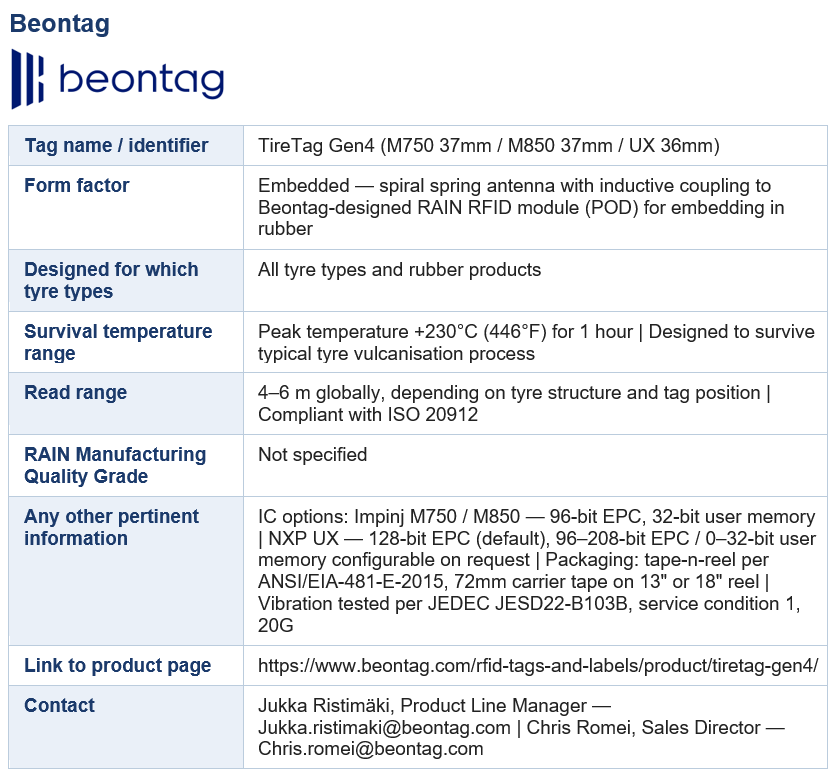
Beontag
Beontag is a leading global inlay and label manufacturer whose TireTag Gen4 family is validated against industry-leading RAIN RFID tyre tag technology and positioning specifications.
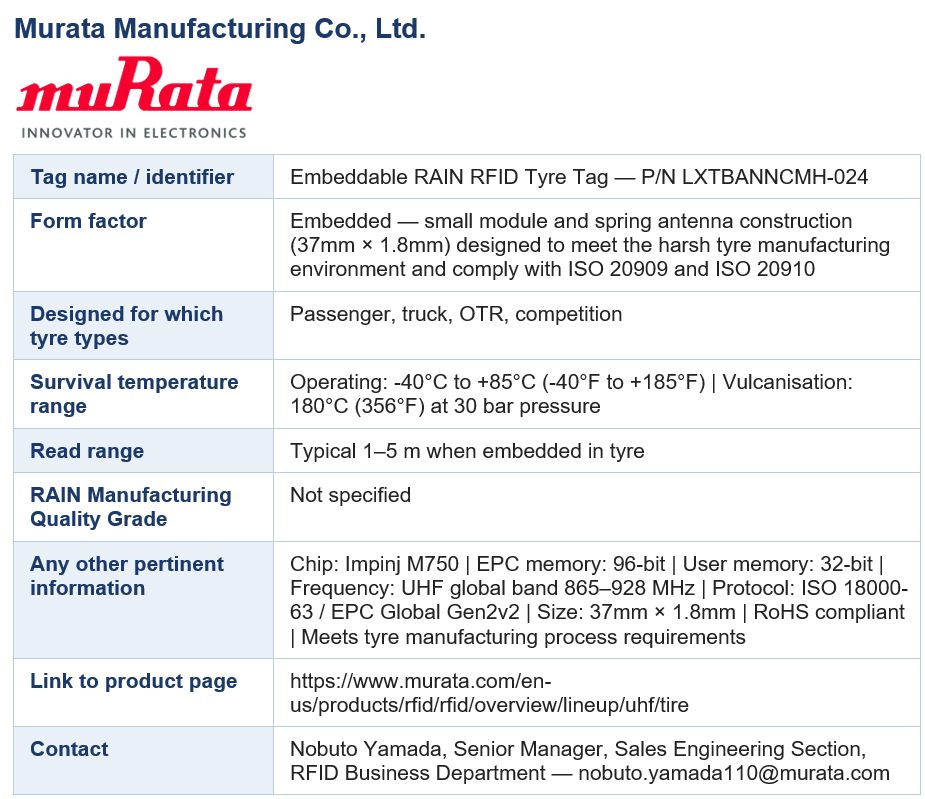
Murata Manufacturing Co., Ltd.
Murata Manufacturing is a global leader in electronic components and has been supplying RAIN RFID embeddable tyre tags to major tyre manufacturers worldwide.
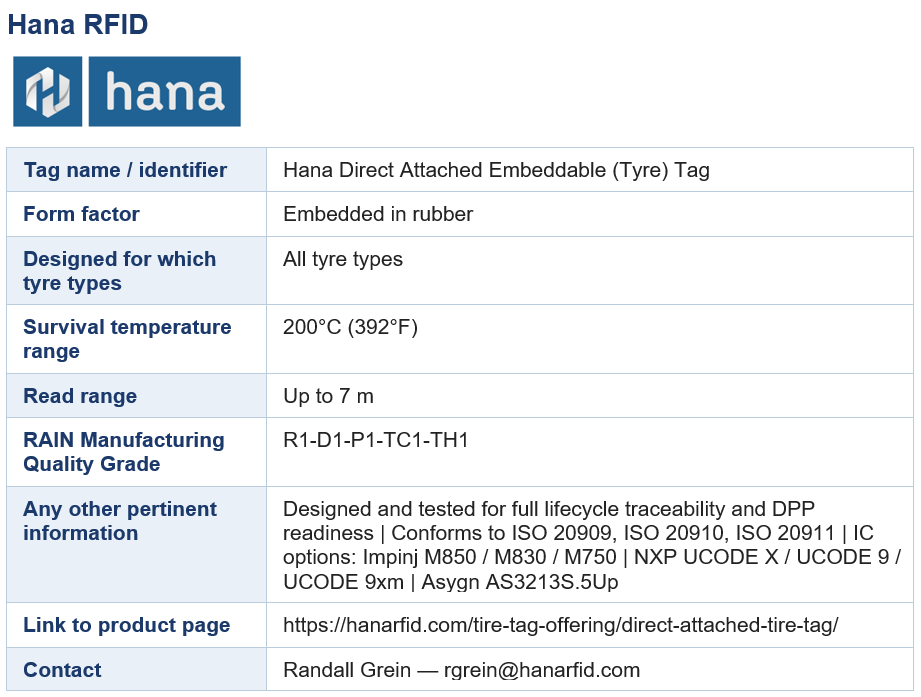
Hana RFID
Hana RFID is a specialist RAIN RFID technology company with a dedicated tyre tag product line, designed and tested for full lifecycle traceability and Digital Product Passport readiness.
What Tyre Manufacturers Should Be Doing Now
The technical foundation is in place. The regulatory direction is confirmed. The manufacturers who move now will be building DPP capability into their products and supply chains while others are still watching the delegated act process unfold.
For manufacturers already using RAIN RFID for supply chain and logistics, the path to DPP compliance is shorter than it might appear — the tag infrastructure is often already there. The work is in structuring the digital record to meet the requirements the delegated act will define.
For those earlier in the journey, the RAIN Alliance member directory in this guide is the right place to start. The full ESPR preparatory study is at ecodesign-tyres.eu — and the RAIN Alliance is actively engaged in the delegated act process for tyres. Now is the time to be part of that conversation.