
Why the future of intelligent operations depends on accurately observing the physical world
Every day, billions of physical objects move through the world’s businesses. Products leave factories, pallets arrive at distribution centers, medical devices move between hospital departments, baggage travels across continents, and inventory flows through stores and supply chains. Each of these movements tells a story about what is happening inside an operation.
For decades, organizations have relied on manual scans, periodic counts, and human attention to understand where their goods are. These methods have served businesses well, but they share a structural limitation: they capture the physical world in snapshots. Between one count and the next, reality drifts, and the record grows quietly out of date. The result is a persistent gap between what is actually happening on the floor and what the enterprise systems believe is happening.
That gap has always carried a cost. What has changed is how much it now matters.
As organizations invest in artificial intelligence, automation, and predictive analytics, they are discovering that the value of these tools is set less by the sophistication of the software than by the quality of what the software knows. Before a model can recognize a pattern, forecast demand, or trigger an action, it has to understand what is happening in the physical world. When that understanding is current and accurate, the results can be remarkable. When it is delayed or incomplete, even an advanced model will reflect those same gaps back to the business, confidently. Artificial intelligence does not create truth. It works from the information it is given.
This is the specific role that RAIN RFID plays. It is often introduced as an identification technology, and it is one, but its greater contribution is to turn the movement of everyday items into a continuous stream of accurate, real-time information, allowing physical operations to become digitally observable. Once an operation can be observed at the level of the individual item, the enterprise software, analytics, and AI built on top of it finally have something they have long struggled to obtain — a reliable picture of what is happening right now.
The best way to understand how this works is not to study a stack of technologies but to follow a single piece of information as it travels through an organization. The journey begins with one RAIN read and ends with a better business decision.
The journey of a single read
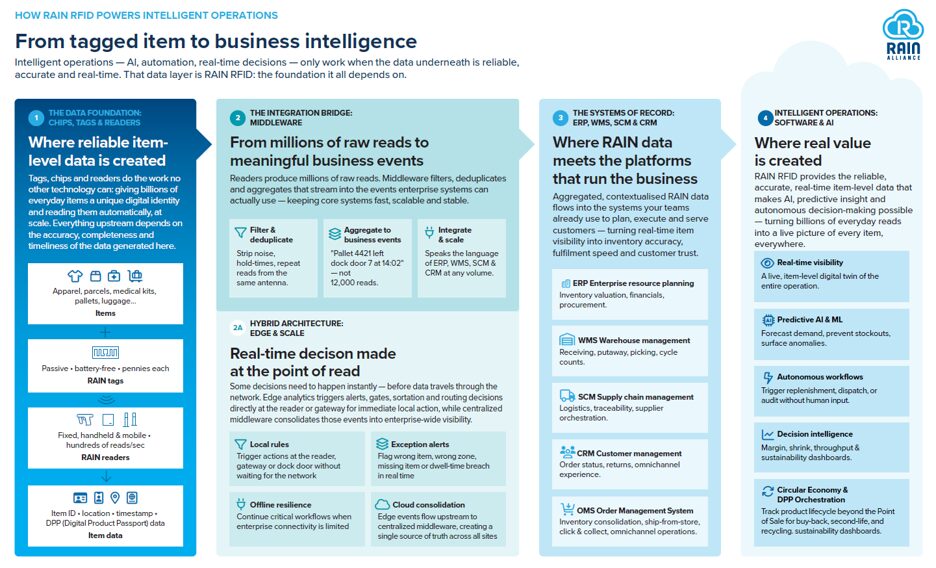
Picture a pallet of products leaving a distribution center through Dock Door 7.
Every carton, even every item, on that pallet carries a RAIN RFID tag, each with its own unique identity. As the pallet approaches the doorway, a RAIN reader powers those tags wirelessly and detects every one of them — hundreds at a time, without anyone scanning anything and without needing a clear line of sight. In that moment, the operation learns which items are present, where they were seen, and exactly when they passed through.
Nothing has been analyzed yet, and nothing has been predicted. The system has simply made an accurate observation of the physical world — the raw material from which everything else will be built. This is the data foundation layer, and its quality determines the quality of every layer above it. Tags and readers doing their work properly is what gives billions of everyday items a dependable digital identity, tied to a specific place and a verifiable moment in time. In the future, that same identity will offer access to the item’s Digital Product Passport, information that will travel with the product for the rest of its life.
Some decisions, though, are too time-sensitive to wait for that information to travel anywhere. Before the observation leaves the dock, the reader or a nearby gateway can evaluate what it has just seen. If the wrong pallet approaches the wrong door, if an expected shipment is missing, or if an item enters a restricted area, an alert can fire immediately so that a person can act. These decisions happen in real time, right where the event occurred, letting the operation respond in the moment while the information continues on its way. It is a practical acknowledgment that some value is realized instantly at the edge, and the rest accumulates as the data moves upstream.
The next step is making that observation useful to the wider business.
On its own, a reader produces a great deal of technical detail. Each tag is read not once but multiple times for as long as it sits in the reader’s field, so a single pallet passing through can generate thousands of individual read messages in moments. Middleware is what turns that detail into meaning. It removes duplicates, sets aside what isn’t needed, and translates that burst of raw reads into a single, plain statement of what happened:
Pallet 4421 left Dock Door 7 at 2:02 PM
That one update is something the business can immediately understand and act on, and it can now be shared with the systems that run day-to-day operations. A warehouse management system can update inventory to show the shipment has left the building. An order management system can send customers a revised shipping status. Whatever enterprise applications are in place, each becomes more useful when it is fed information that is timely, accurate, and true to the physical world.
Only now does the final stage of the journey begin.
Because the information underneath is trustworthy, software can do far more than record what happened. It can maintain a live, item-level digital twin of the operation — a continuously accurate model of what exists and where, rather than a snapshot from the last count. Predictive models can forecast demand and anticipate stockouts with real confidence, because they are learning from what is actually moving. Automated workflows can act on their own: reordering stock before a shelf runs empty, releasing a shipment the moment it is verified complete, or flagging an exception before it becomes an expensive problem. Decision-makers gain dashboards that track margin, shrink, throughput, and sustainability against reality rather than estimates. And because each item can be followed well beyond the point of sale, the same foundation supports circular-economy programs — buy-back, resale, and recycling — and the Digital Product Passport reporting.
The intelligence did not appear at the end of the journey. It was assembled, step by step, from a single accurate observation.
Value at every level
This example follows one pallet through one doorway, but variations of it play out millions of times a day. A garment entering a retail stockroom, a surgical tray moving through a hospital, baggage passing through an airport, reusable containers circulating through a plant, goods crossing a global supply chain — each travels its own path, shaped by the item it is and the industry it moves through. What they share is not a route but a pattern: a physical event becomes trusted information, trusted information keeps operational systems accurate, and accurate systems give analytics, automation, and AI something dependable to work from. The specifics differ everywhere; the sequence holds universally.
Because the sequence holds, the same real-time, item-level data produces comparable gains across very different operations. In retail, item-level visibility has moved inventory accuracy into the high nineties, making ship-from-store and true omnichannel fulfillment dependable rather than hopeful. In healthcare, automatic tracking of instruments and supplies improves patient safety and turns recall management from a matter of weeks into a matter of hours. In aviation, near-total read rates let travelers follow their bags in real time. In manufacturing, tags that withstand heat, paint, and washdown carry traceability through the entire production process. The applications look nothing alike, yet the underlying move is identical: RAIN technology made the operation observable, and the intelligence followed.
The most important idea in this diagram is that a single stream of accurate, item-level data from RAIN technology informs decisions at every level of the operation at once. The same observation that lets a worker stop the wrong pallet at the dock door also keeps the warehouse system’s inventory honest and gives the forecasting model something real to learn from. Value appears at the edge, in the systems of record, and in the intelligence layer — all drawn from the same source, wherever and whenever a decision needs to be made.
This is what RAIN RFID offers a business: a truer sense of what is happening, in real time, that people and software can act on with confidence. Intelligent operations do not begin with a dashboard or a model, they begin with accurately observing the physical world. For organizations investing in that future, RAIN technology is where the intelligence starts, and one of the most valuable assets they can build on.