
Billions of single-use containers — cups, trays, bottles, food boxes — are produced, used once, and discarded every year. Regulators across Europe have said this must change and are accelerating the move away from single-use materials toward reusable and recyclable systems.
The EU’s Packaging and Packaging Waste Regulation (PPWR) requires all packaging on the market to be reusable or recyclable by 2030, with single-use plastic packaging banned for specific categories from January of that year. The EU Single-Use Plastics (SUP) Directive is already in force. And France has gone further still: the AGEC Law (No. 2020-105), which came into effect in January 2023, requires quick service restaurants to offer reusable tableware to dine-in customers, with a full ban on single-use plastic packaging by 2040.
For food operators, these are immediate operational challenges, not long-term ambitions. Meeting them requires more than alternative materials. It requires the ability to track, manage, and recover packaging at scale.
The tracking problem nobody talks about
Reusable packaging only delivers its circular economy promise if it actually gets reused. That sounds obvious, but in practice, without item-level visibility, operators face uncontrolled stock loss, inaccurate inventory, and no credible data to demonstrate compliance. A container that disappears into a bin rather than a collection point is not reusable. It is just a more expensive piece of single-use waste.
RAIN RFID solves this by encoding a unique digital identity directly into each container at the point of manufacture, one that persists through dishwasher cycles, microwave heating, and hundreds of reuse cycles, enabling full traceability from production to point of use and back.
What this looks like in practice
Three case studies from the RAIN Alliance document how RAIN Alliance members are making this a commercial reality across very different food environments.
 Chinook — the world’s first microwave-safe RAIN RFID inlay
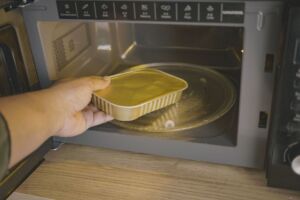 Chinook — the world’s first microwave-safe RAIN RFID inlay
Developed by Checkpoint Systems and independently tested by the European EPC Competence Center (EECC), Chinook maintains more than 50% of its maximum read range after 45 microwave cycles. That certification matters because it unlocks a category that was previously inaccessible to RFID traceability: ready meals, fresh food, and prepared products that go from packaging to microwave to table. Chinook is compatible with plastic and glass packaging across fresh, frozen, and prepared food categories, and is suited to supermarkets, catering services, fast food chains, and delivery operators. It also complies with ISEGA indirect food-safe adhesive standards — meaning it can be embedded into packaging that comes into contact with food without safety concerns.
 Global fast food chain — 1,200+ restaurants, one national mandate
 Global fast food chain — 1,200+ restaurants, one national mandate
When the AGEC Law came into force in January 2023, a leading global fast food chain needed to replace single-use tableware across more than 1,200 restaurants, nationwide, immediately. Following a two-year consultation process, Checkpoint Systems designed and deployed the solution: the first food-safe, heat- and water-resistant RAIN RFID system applied to fast-food tableware at national scale, covering cups, bottles, and fries containers across the entire estate. The system delivers up to 99% inventory accuracy, automated replenishment data, and item-level location tracking — including the ability to detect containers accidentally discarded in bins before they are permanently lost from circulation.
Sykell automating the reuse workflow from the inside out
Avery Dennison addresses a different but equally important challenge: the operational bottleneck inside the reuse workflow itself. In a pilot, RAIN RFID labels were applied to reusable food containers and tracked automatically through every stage of the washing facility: arrival, counting, washing, and preparation for redistribution. The impact was immediate: a 30% reduction in labour costs, 33% faster clearing of returned dirty containers (from two minutes per box to 30 seconds), 50% faster commissioning of clean containers for redistribution, and 99.5% read accuracy at full pallet level. Crucially, this case shows that RAIN RFID doesn’t just help operators comply with reuse mandates — it makes the economics of reuse significantly more attractive.
The common thread
These three deployments look different on the surface — a microwave-safe inlay for retail, a national QSR rollout driven by legislation, and a startup pilot focused on washing facility efficiency. But all three reflect the same underlying reality: reusable packaging without traceability is not a circular economy solution. It is an operational liability.
RAIN RFID turns reusable packaging from a compliance burden into a competitive advantage — delivering the inventory accuracy, waste reduction, and verifiable sustainability data that regulation now demands and that operators increasingly need to run efficient, profitable businesses.
Read the full case studies to explore how RAIN Alliance members are using RAIN RFID to make reusable food packaging traceable, compliant, and commercially viable.