
From pilot schemes to permanent business models — the technology making reuse as easy as single-use.

The world has a single-use problem. We know this. But we are moving past the era of awareness and firmly into the era of infrastructure, and the infrastructure that is quietly making reuse work at real scale is RAIN RFID.
At a recent RAIN Alliance webinar on reuse models, practitioners from Blenheim Palace, Imperial College London, platform provider RE Universe, and policy body WRAP came together to share hard-won lessons from the front lines of implementation. What emerged was a compelling picture of how item-level intelligence transforms reuse from a well-intentioned idea into a commercially viable, scalable system.
Watch the full webinar recording here: [RAIN Webinar: Reuse Models — Turning Smart Payments into Smart Savings]
From Trust-Based to Controlled Asset Systems
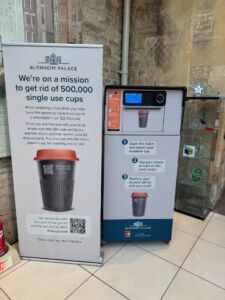
 Blenheim Palace serves around 400,000 hot drinks a year. When they first launched a reusable cup scheme, they did what most organizations do: they trusted people. Within a couple of weekends, 2,000 cups had vanished with no tracking, no traceability, and a significant financial loss. The lesson was blunt — trust is not a system.
Enter RAIN RFID. By embedding tags in reusable cups, Blenheim moved from a trust-based model to a controlled asset system. Every cup is now tracked from point of sale through washing and redistribution. Stock counts are automated. Return rates are measured. And crucially, the scheme now runs at roughly half the cost of single-use cups — proving that sustainability and financial viability are not at odds.
As David Green, Head of Innovation at Blenheim Palace, put it: “We want to be net zero by 2027. But my aim right from the start was to prove we could do this at a lower cost than single-use.” RAIN RFID made that proof possible.
Removing Friction Is Everything
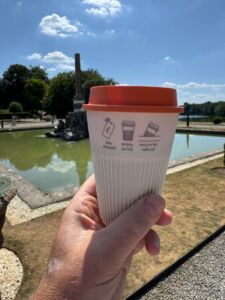 One of the most powerful insights from the webinar was how friction kills reuse schemes. Apps, QR codes, manual scanning, deposit-return portals — every extra step reduces return rates and erodes the consumer experience. Early pilots at Blenheim showed this clearly: even with financial incentives, complex return processes kept participation low.
RAIN RFID solves this elegantly. Its high-speed bulk reading capability means cups are captured automatically at return points — no line-of-sight required, no manual scanning, no app needed. Tony McGurk, Founder and CEO of RE Universe, described the goal simply: “We need to make reuse equivalent to single-use.” With tap-and-go returns linked directly to payments, that experience is now achievable.
Data Turns Anecdotes into Action
“If you don’t have the data, all you’ve got is an anecdote.” That observation from RE-universe captures why item-level data is so central to circularity at scale. RAIN RFID doesn’t just track cups, it generates the granular intelligence needed to model asset lifetimes, predict loss, and continuously optimize operations.
Imperial College London is one month into their own campus reuse pilot, and the data is already revealing surprises. Before the trial, 15% of customers chose a sit-in ceramic cup. Today, that figure has jumped to 50%. The scheme is changing behavior in ways that weren’t predicted, prompting people to pause at the till and choose the genuinely right option rather than defaulting to takeaway. That behavioral data will directly shape how the full campus-wide rollout is designed.
From Cups to the Circular Economy
The panelists were unanimous: reusable cups are the proof of concept, not the destination. As Tony McGurk noted, “cups are the pre-show dinner drink” — the real opportunity lies in fast-moving consumer goods (FMCG), where RAIN RFID-enabled reuse could transform the packaging of everyday consumer goods at massive scale.
That scaling conversation is also happening at the policy level. The UK’s upcoming Packaging Pact in 2026 will extend focus beyond plastics to all packaging materials, and panelists from WRAP highlighted the critical role technology must play in aligning commercial models with regulatory targets and consumer behavior change.
The infrastructure for a circular economy isn’t hypothetical. It is being built right now, tag by tag, return by return. RAIN RFID is the silent partner making it work — turning reuse from an aspiration into an operational reality.
Watch the full webinar recording, RAIN RFID Effect on Reuse Models: Turning Smart Payments into Smart Savings, to hear the full conversation from Blenheim Palace, Imperial College London, RE-universe, and WRAP.