
Joint Position Paper: Advancing DPPs with GS1 Identifiers and RAIN Technology
Our two organisations, GS1 and RAIN Alliance, greatly value regulatory requirements globally, and especially in the European region. For this reason, the focus of this joint statement is particularly on the EU Digital Product Passport provisions, stemming from the Ecodesign for Sustainable Products Regulation[1] (ESPR) that aims to make the environmental impact of products transparent throughout their lifecycle by leveraging efficient digital solutions.
GS1 is a neutral, not-for-profit supply chain standards organisation with Member Organisations located in 118 countries, delivering global standards to improve the efficiency, visibility, and sustainability of product data.
The GS1 system includes standards for item, location, and entity identification using linear and 2D barcodes and radio identification (RAIN) tags as well as business-to-business standards enabling e-commerce and data synchronisation. GS1 has over 50 years of experience in global standards setting, and the GS1 standards system is the most widely used in retail supply chains globally. GS1 users support co-existent and interoperable use of data carriers, and are supporting the initiative to make smart device reading of RFID a reality by working in the GS1 standards process (GSMP) to agree on a syntax that will be used to make this happen.
The RAIN Alliance is a neutral, not-for-profit industry association that enables organizations to improve traceability, effectiveness, and sustainability by simplifying, standardizing, and accelerating the adoption of RAIN technology through global collaboration and innovation.
RAIN Alliance is actively supporting the Digital Product Passport (DPP) initiative in the European Union (EU), with our mission of creating a smarter and more sustainable world by using RAIN RFID technology to connect trillions of everyday items across their entire lifecycle, simply and inexpensively. RAIN Alliance firmly believes that RAIN is a well-positioned data carrier solution for DPPs with its unparalleled advantages in traceability and circularity, and is necessary to support the EU’s goal of unlocking a circular economy at scale. RAIN Alliance members are leading the initiative to make smart device reading of RAIN RFID a reality, working with all the key stakeholders in the value chain.
Both organisations recognise the critical role that standardized product identification, data exchange and RAIN-enabled digitalisation will play in enabling industry compliance. Based on our common user base, this joint statement intends to amplify the messages from our shared members to combine RAIN technology and GS1 identifiers for DPPs, starting with the prioritised sectors in the first ESPR Working Plan for 2025-2030 that are textile, tyres, and furniture.
GS1 and RAIN Alliance collaborative efforts span multiple industries, including tires and textiles, as well as logistics. By enabling interoperability and improving supply chain visibility, our joint work supports circular economy principles, facilitating better end-of-life processing and waste reduction.
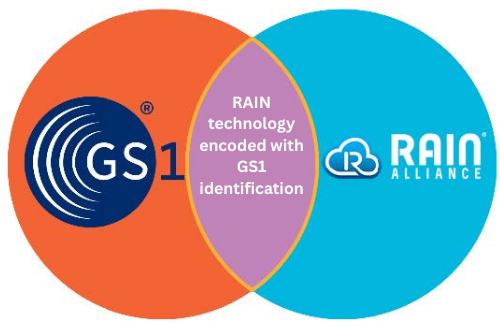
Please see below for a set of selected DPP statements from our shared members from the textile and tyres industry as well as RAIN technology providers. These statements help show how the combination of global, open GS1 identification standards and RAIN RFID technology can enable automatic and scalable access to this data – at item-level precision and across complex supply chains.
For more information on GS1 public policy activities, please contact:
- Francesca Poggiali – Vice President, Global Public Policy, GS1 Global Office, ([email protected])
- Nora Kaci – Senior Manager,Public Policy Europe, GS1 Global Office, ([email protected])
- Francesca Chiovenda – Assistant Manager, Public Policy, GS1 Global Office, ([email protected])
For more information from RAIN Alliance, please contact …
- Aileen Ryan, CEO, RAIN Alliance, ([email protected])
- Susanne Guth-Orlowski, DPP Specialist, RAIN Alliance, ([email protected])

Avery Dennison, as a member of the RAIN Alliance, fully supports the joint focus of GS1 and RAIN Alliance on enabling Digital Product Passports (DPPs) through standardized identification and RAIN RFID enabled digitization. DPPs are being explored across a wide range of sectors such as tires, textiles, furniture and others, because of their potential to improve transparency, traceability, and sustainability. In the EU, this interest extends beyond products covered by the Ecodesign for Sustainable Products Regulation (ESPR), and is also driven by other product-specific regulations including the Toys Safety Regulation or the Batteries Regulation. Similarly, product traceability is a focus of international initiatives such as the FAO Sustainable Food Value Chain. Alignment across different sectors, harmonization of different DPP standardization initiatives such as those led by CEN-CENELEC, ISO, and IEEE, along with combinable data carriers (such as RAIN RFID and 2D barcodes), will be critical to achieving scalable, secure, and interoperable adoption. We also emphasize the need for robust resolver and data access infrastructure, along with strong security and privacy measures, to ensure scalable, trusted DPP implementations that effectively support the circular economy.
Avery Dennison Corporation (NYSE: AVY) is a global materials science and digital identification solutions company. We are Making Possible™ products and solutions that help advance the industries we serve, providing branding and information solutions that optimise labour and supply chain efficiency, reduce waste, advance sustainability, circularity and transparency, and better connect brands and consumers. We design and develop labelling and functional materials, radio-frequency identification (RFID) inlays and tags, software applications that connect the physical and digital, and offerings that enhance branded packaging and carry or display information that improves the customer experience. Serving industries worldwide – including home and personal care, apparel, general retail, e-commerce, logistics, food and grocery, pharmaceuticals, and automotive – we employ approximately 35,000 employees in more than 50 countries. Our reported sales in 2024 were $8.8 billion.
Source: www.averydennison.com

Charming, as a member of both organizations, enthusiastically supports the collaborative statement from GS1 and the RAIN Alliance. This statement effectively highlights the key role that GS1 identifiers and RAIN RFID technology will play in creating scalable, interoperable Digital Product Passports (DPPs).
This powerful synergy is expected to not only help brands comply with regulations like the EU’s ESPR framework but also to drive significant circular economy benefits. By enabling seamless traceability, enhanced sustainability, and greater transparency, this collaboration promises to provide a complete view of a product’s lifecycle, from its creation to its downstream events.
At Charming, we’ve long advocated for this standards-driven approach to interoperability. Our core solutions, including our RFID-enabled labels and tags, our RFID Middleware, and our consumer-facing DPP platform, are all built on the foundational principles of RAIN RFID technology and GS1 Digital Link. This ensures our customers have the tools they need to connect their products to a digital future.
We’re excited to continue our collaboration with GS1 and the RAIN Alliance, and we look forward to making Digital Product Passports a practical reality for the textile, apparel, and broader retail sectors.
https://blog.charmingtrim.com/why-digital-product-passports-belong-in-your-marketing-strategy
https://blog.charmingtrim.com/how-gs1-is-transforming-from-basic-barcodes-to-digital-intelligence

Checkpoint Systems – As global supply chains come under increasing pressure and scrutiny, companies across all sectors and industries are turning to RAIN RFID to drive efficiencies and enable item level visibility.
Checkpoint supports the GS1 and RAIN Alliance joint statement aimed at standardizing data capture points and RFID-driven digitization for the deployment of Digital Product Passports (DPPs), in our position as a global leader in innovative RFID hardware, software, and labeling solutions.
In order to stay compliant and on the right side of overwhelming public demand for transparency, companies need a solution built around consistent and well-structured data that works now while the requirements are being finalised, and in the future when consumers have a direct link to vital product information.
As close partners with both GS1 and the RAIN Alliance, we’re excited about this continued collaboration with key industry partners, and the benefits this will bring to global brands.
https://checkpointsystems.com/apparel-labeling-solutions/digital-product-passport/
https://checkpointsystems.com/blog/gemini-tag-solving-qr-code-labels/

Decathlon – “[Decathlon] firmly assert that the utilization of RAIN RFID technology as a data carrier with GS1 encoding stands as a de-facto reference solution for any Digital Product Passport (DPP) system. This assertion is substantiated by attributes such as granularity at the item level, ease of data retrieval, and its widespread international adoption. These qualities make RFID technology indispensable, extending its necessity beyond the point of sale.”
Source:

EM Microelectronic – For over 35 years, EM Microelectronic has been a pioneer in RFID technology, delivering innovative and differentiated RAIN RFID and NFC solutions. Our unique em|echo dual-frequency (HF+UHF) product family seamlessly combines B2B supply chain traceability with B2C smartphone-based product interaction, enabling intuitive and secure product identification, naturally expanding the reach of GS1’s ecosystem into the consumer space as a key enabler for DPP.
EM Microelectronic works closely with GS1 to advance global standards and was the first IC manufacturer in the world to launch a GS1 Gen2v3-compliant chip. Our collaboration extends to enabling GS1 Digital Link over NFC, bridging the physical and digital worlds for smarter product experiences.
As a board member of the RAIN Alliance and a GS1 solution partner, EM Microelectronic strongly believes that RFID is a foundational technology for circular economy initiatives and the upcoming Digital Product Passport (DPP) regulations.
Sources:

FineLine Technologies, as a member of both GS1 and the RAIN Alliance, fully supports the vision of Digital Product Passports as a critical enabler of transparency, sustainability, and circular economy initiatives. DPPs—digital profiles tied to unique product identifiers—are poised to transform manufacturing, lifecycle visibility, and consumer trust.
As a leader in variable-data labeling, FineLine is uniquely positioned to bring DPP ambitions to life using our FASTtrak platform. We ensure every item is assigned a secure, item level identifier (RAIN RFID, 2D barcode, or human readable), and associate it with metadata such as manufacturing origin, lot, purchase order, and shipment details—capturing traceability from birth.
Our infrastructure is based on industry standards, including GS1 and RAIN RFID—technologies already embraced globally for their robustness and interoperability. FASTtrak enables secure generation, encoding, and real time management of these unique data elements, making FineLine’s solution not only compatible but complementary to DPP frameworks.
FineLine is ready to collaborate with brands, retailers, and regulators to integrate DPP requirements seamlessly. Our existing capabilities in item-level marking, secure data management, and global print-and-encode logistics (48-hour turnaround worldwide) mean brands can adopt DPPs with confidence—and without disrupting their supply chain operations.
Sources:
- www.finelinetech.com
- www.finelinetech.com/company/sustainability/#DPP
- www.finelinetech.com/solutions/brand-authentication-track-and-trace/

HID – “A DPP plans to include a unique product identifier […] along with crucial data on materials, sourcing, manufacturing processes and sustainability metrics.”
An example may be a serialised GS1 identifier encoded as an Electronic Product Code (EPC) in a passive RAIN RFID tag.
Source:

Impinj – The item-level visibility and traceability delivered by RAIN RFID have already made countless supply chains more efficient and less wasteful, in line with the aims of the Digital Product Passport (DPP) initiative – making RAIN RFID a natural DPP data carrier. The RAIN Alliance and GS1 diligently nurture the standards, identifiers, security, and data governance necessary to deliver DPPs to consumers’ fingertips. Impinj proudly works closely with both associations as we pursue our mission to connect every thing and, in so doing, improve people’s lives.
Source:

Michelin coordinates the tyre DPP pilot of the CIRPASS-2 EU funded project, that brings together 12 companies and associations to test the digitalization of the circular value chain on various real life use cases. What is it about? “Technically, our pilot will rely on GS1 identifiers, ISO standards of [RAIN] RFID technology for tires and GDSO services, the tire industry dataspace created in 2022 to share data in a standard manner around connected tires.” For tire applications in the project, UII shall be coded using SGTIN-96 as per GS1 EPC Tag Data Standard.
Sources:
- Video: Michelin_Video_DPP Position Paper_2024.mp4
- Interview: Claire Fioretti, head of standards and regulations for connected mobility, Michelin | Tire Technology International
- Video: PC1 Michelin – Cirpass2

Nedap – As sustainability and transparency gain global focus, technologies like Digital Product Passports (DPPs) and [RAIN] RFID are reshaping retail and supply chains. The fashion industry with its high environmental impact can greatly benefit by enhancing sustainability, efficiency, and consumer trust. “Adopting these technologies is not just a necessity—it’s an opportunity to lead.“
Sources:

NXP Semiconductors sees Digital Product Passports (DPPs) as essential for enabling product traceability and effective lifecycle management. Various automatic identification technologies can serve as a data carrier for DPP, this includes RAIN RFID, supporting organizations in achieving greater transparency and efficiency throughout a product’s lifecycle ultimately improving sustainability.
Source:

SML welcomes and supports the joint statement from GS1 and the RAIN Alliance reinforcing the critical role of global standards, RAIN RFID technology, and item-level identification in enabling Digital Product Passports (DPP).
As a global leader in digital identification and RFID solutions, SML is proud to provide end-to-end DPP solutions, combining both DPP-ready products like Inspire™ Care Labels, Heat Transfers, Woven Labels and SmartPeel along with our dedicated DPP data management platform. Our integrated approach empowers brands to not just seamlessly capture, manage, and share the product data required under the EU Ecodesign for Sustainable Products Regulation (ESPR) and other global sustainability mandates but also to leverage this value adding opportunities beyond compliance.
SML solutions are built on GS1 standards and RAIN RFID technology, ensuring full interoperability, item-level traceability, and scalability across complex global supply chains. By delivering both physical and digital DPP components, we help retailers and manufacturers accelerate their DPP readiness, support circular business models, and drive greater product transparency and sustainability.
We look forward to continued collaboration with GS1, the RAIN Alliance, and industry partners to help make DPP a practical reality for the textile, apparel, and broader retail sectors.
Source:

Tageos highlights RFID technology as a key enabler of high-quality unique identifiers for the Digital Product Passport (DPP). As integral components of the DPP, RAIN RFID inlays and tags offer significant benefits – including durability, long service life, reliable data accessibility, cost-effectiveness, and a low environmental impact in terms of both carbon emissions and waste.
To meet the tagging requirements of a wide variety of product types, Tageos supports its customers with a broad portfolio of high-quality RAIN RFID inlays and tags. The company also develops specialised inlays and tags for specific goods – such as chemicals, electronics, apparel, furniture, and toys – which must be precisely engineered to suit each product’s environment and requirements.
Source:

Trimco Group accelerates digital transformation in the fashion and sports industries by delivering scalable RFID-enabled traceability and data management, both fundamental to DPP initiatives and ensuring global compliance. As a key collaborator with RAIN Alliance and GS1, we integrate RAIN RFID and GS1 standards to enable item-level identification and full product histories, directly addressing evolving EU and sector-specific regulations.
We supply, manufacture, and deliver RFID tags, ensuring accuracy across every detail. Our unique approach relies on close collaboration with a broad network of industry experts, software providers, and service partners within the RFID ecosystem. This enables us to remain agile, objective, and current—continuously updating our offerings to meet the fast-changing demands of technology and regulation. With operations in over 27 countries and partnerships with more than 1,200 brands, Trimco Group offers secure, interoperable platforms—such as ProductDNA®—enabling end-to-end supply chain traceability and robust sustainability claims. Through alignment on standards, secure data access, and privacy, we help brands manage complex DPP requirements and set new benchmarks for supply chain transparency and responsible, future-ready fashion.
Sources:
- https://www.trimco-group.com/solutions/digital-product-passport
- https://www.trimco-group.com/newsroom/hessnatur-pilots-in-garment-rfid-tags-with-qr-codes

Zebra Technologies’ RAIN RFID solutions, utilizing GS1 standards, encode unique identifiers like GTINs onto RFID tags, enabling item-level tracking and data capture for the EU’s Digital Product Passport (DPP). Integrated with GS1 Digital Link, Zebra’s RFID solutions connect physical products to cloud-based DPP records, providing real-time access to lifecycle data such as material composition and recycling instructions. Through partnerships with our community of software providers, Zebra is an integral part of a comprehensive DPP solution, simplifying large-scale data management and ensuring compliance with the EU’s transparency and sustainability requirements across industries like tires, textiles, and electronics.
Sources:
- https://www.zebra.com/gb/en/blog/posts/2025/how-a-secret-wire-tracked-a-pair-of-jeans-around-the-world.html
- https://www.zebra.com/gb/en/blog/posts/2023/is-your-business-ready-to-comply-with-eu-digital-product-passport-legislation.html
[1] https://eur-lex.europa.eu/legal-content/EN/TXT/?uri=CELEX%3A32024R1781&qid=1719580391746