
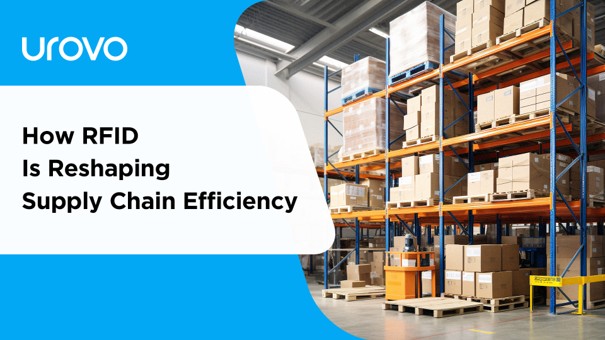
 Supply chains are under growing pressure to move faster and operate with greater accuracy than ever before. Yet many warehouse and parcel sorting operations still rely heavily on barcode scanning — a process that requires manual, line-of-sight reading of individual items. In high-volume logistics environments, this creates operational bottlenecks and increases labor dependency and higher operating costs.
At the same time, customer expectations have evolved rapidly — from next-day delivery to same-day and even one-hour fulfillment. These growing demands are accelerating the shift toward smarter, faster, and more automated supply chain systems.
RAIN RFID is Accelerating Logistics Transformation
As industries such as retail continue expanding RAIN RFID deployment, the costs of RAIN tags are steadily declining. More importantly, RAIN RFID enables automatic and high-accuracy bulk item identification, making the large-scale deployment in logistics more practical and cost-effective.
Higher inventory efficiency helps businesses reduce misplaced inventory, improve overall resource utilization and optimize pricing strategies. Over time, these operational gains can significantly offset the upfront investment required for RAIN RFID implementation.
According to Fortune Business Insights, the global RAIN RFID market is projected to grow from USD 19.01 billion in 2026 to USD 46.2 billion by 2034.
There are growing reasons for businesses to adopt RAIN RFID. The latest developments in RAIN RFID technology have significantly improved the ability to automate cargo tracking across logistics networks — from monitoring inventory flow in and out of warehouses to ensuring the right parcels are loaded onto the correct delivery vehicles. Companies can achieve highly accurate, real-time visibility with lower labor costs, reducing waste while improving overall operational efficiency.
Recently, UPS announced the large-scale deployment of radio frequency identification (RAIN RFID) package sensing across its U.S. small package network, delivering visibility and reliability for customers of all sizes. UPS has invested more than USD 100 million in strengthening its logistics network, with this RAIN RFID deployment representing a groundbreaking innovation in logistics.
UROVO RAIN RFID Solutions: Enabling Real-Time Visibility for Warehouse Operations
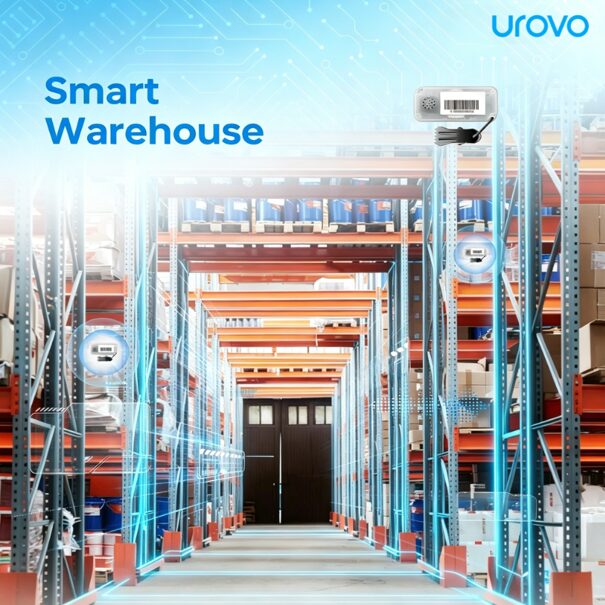
UROVO provides a comprehensive RAIN RFID-powered logistics solution designed to help logistics enterprises enhance digital management capabilities across warehousing, transportation tracking, parcel sorting, and delivery operations.
By embedding RAIN RFID tags in products, cartons, reusable bags, totes, pallets, shelves, and other operational assets — while deploying RAIN RFID readers at warehouse workstations, entry and exit checkpoints, and distribution centers, businesses can capture operational data quickly and accurately throughout storage, transportation, and delivery processes.
This improves traceability, operational transparency, and overall logistics efficiency.

Automated Warehouse Management
Efficient Receiving and Dispatch
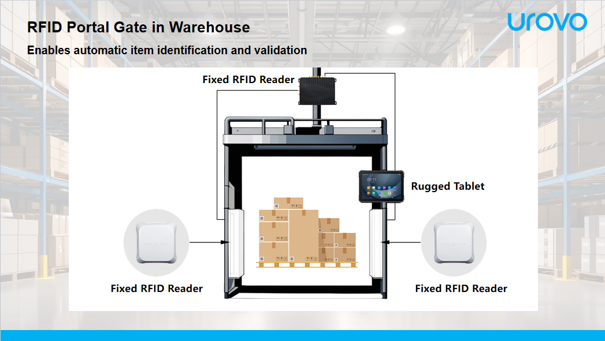
By deploying UROVO fixed RAIN RFID readers at warehouse receiving and shipping docks, tagged parcels or pallets can be automatically detected and processed as they move through the checkpoint.
The system enables real-time identification, registration, and data synchronization automatically, improving receiving efficiency by more than 70% while reducing missed scans and scanning errors.
 Inventory Location Binding & Putaway Management
RAIN RFID enables seamless linkage between pallets or containers and their associated cargo data, ensuring continuous traceability throughout the logistics process. Forklifts equipped with industrial tablets and RAIN RFID fixed readers can visualize cargo locations, improving warehouse space utilization and operational efficiency.
Accurate Picking and Inventory Counting
For picking operations, UROVO short-range RAIN RFID handheld terminals enable highly accurate item picking, with reading distance adjustable down to approximately 1 cm. For inventory counting, long-range RAIN RFID mobile terminals can read multiple tags at once, dramatically reducing inventory counting time.
 Sorting and Transportation Management
Parcel Consolidation and Distribution
In parcel sorting and transfer operations, RAIN RFID handheld mobile terminals can intelligently identify RAIN RFID reusable logistics bags, enabling end-to-end traceability across the entire “parcel-bag-vehicle” workflow. This provides real-time visibility into shipment status at every stage of the logistics process, improving operational control and efficiency.
 Last-Mile Delivery
Instant Parcel Location
By deploying RAIN RFID Pick-to-Light tags at pickup stations, staff can quickly locate parcels using UROVO handheld mobile terminals. When a package is selected in the system, the corresponding tag is triggered to light up instantly, allowing customers and staff to find parcels within seconds.
Tasks that previously took several minutes can now be completed in several seconds, significantly improving customer experience and pickup station throughput.
 End-to-End Visibility Across Reverse Logistics
Leveraging the uniqueness of RAIN RFID tags, businesses can use handheld or fixed RAIN RFID readers to track returned parcels in real time throughout sorting, inspection, storage, and restocking processes.
This can reduce return processing cycles from several days to just a few hours while improving the management efficiency of high-value or delayed return items.
Conclusion
The transition from manual barcode scanning to RAIN RFID-enabled sensing represents more than a technology upgrade. It reflects a broader shift toward real-time, data-driven supply chain operations.
Looking ahead, UROVO will continue integrating RAIN RFID with AI and IoT technologies to help logistics enterprises build smarter, more efficient, and more transparent logistics operations for the future.

For more information, please visit: en.urovo.com
Email: [email protected]