

What sortation pilots and recycling trials tell us about RAIN RFID’s place in the circular economy
Author: Samin Aayanifard
Sustainability Community member, RAIN Alliance
Senior Research Engineer – Advanced Technology, Impinj
The Circular Economy Needs More Than Good Intentions
The pressure on the textile industry to recover garments at end of life, sort them intelligently, and return their materials back into production — to “close the loop” — has never been greater. France has led the way since 2007, when it became the first country to establish an Extended Producer Responsibility (EPR) scheme for textiles, requiring brands to fund collection and sorting infrastructure. Since then, the European Union’s Digital Product Passport (DPP), California’s SB 707, and a growing wave of Extended Producer Responsibility (EPR) programs have created regulatory expectations that are reshaping how brands think about the full lifecycle of products – requiring real accountability for where their products come from and end up, and what happens to them when consumers are done with them. At the same time, brands themselves are making voluntary commitments to recycled content and circular design, driven by consumer expectations and the recognition that a linear take-make-discard model is no longer sustainably, economically or environmentally sound. The language of circular fashion is everywhere, and the infrastructure to back it up is now urgently needed.
But ambition and infrastructure are two different things. Sorting and recycling textiles at scale remains genuinely hard. Most facilities process mixed-fiber bales with no reliable way to identify material composition at speed and at scale. Garments do carry information – fibre content, construction details, care instruction – on labels inside, but reading that information manually across thousands of items per hour is simply not viable. The data needed to sort a garment intelligently and accurately— what it is made of, how it was constructed, whether it can be recycled or redirected to reuse —needs to be accessible automatically, at the point of sorting, for the system to work.
Embedded and durable RAIN RFID tags, sewn into garments at the manufacturing stage, are designed to function across the full lifetime of the product — from the retail floor through years of wear to the point where the garment is no longer wanted. That real-time, persistent identification is becoming a key benefit of embedded RAIN tagging, with the potential to help transform the textile system from a linear model of waste into a circular model of value, where a garment’s identity and history travel with it all the way to recovery. Retailers and manufacturers are increasingly shifting toward this kind of embedded tagging, with major brands already making the transition. These early movers are starting to demonstrate meaningful potential at the other end of a garment’s life. An early evidence base is forming, and it is worth examining: what does it actually show, and what work still lies ahead?
Where Things Stand Today
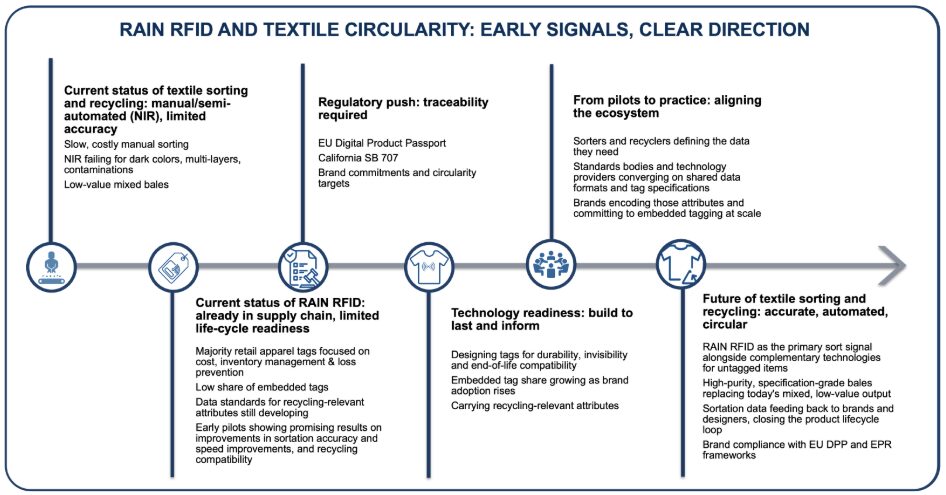
Understanding the opportunity starts with a clear picture of where things currently are. RAIN RFID is a mature, proven technology — billions of tags deployed globally, robust reading infrastructure, and a well-established track record for item-level identification in retail and supply chain contexts. What is newer, and still developing, is its application to what happens after a garment has served its purpose. A few things shape the current state of play:
- Sorter and recycler readiness varies across the industry
- Data standards for end-of-life applications are still being defined
- Tagged garment share in the Textiles End of Life Services is growing steadily
- Tag design is evolving toward full lifecycle compatibility
Sorters and recyclers are not yet aligned on how to handle tagged garments. Views on which contaminants and disruptions their processes can tolerate vary significantly across the industry, and textile recycling itself is still a process in development — standards and thresholds are still being worked out. As more pilots generate data and dialogue between technology providers and end-of-life operators deepens, that picture is beginning to clarify.
Garment attributes that sorters and recyclers need — fibre composition be stored on the garment tag itself, but they can be linked to it. A RAIN tag’s unique identifier connects to a product record held in a database, and that record can carry as much information as the industry needs. The challenge today is that the industry has not yet fully aligned on what that data should include or how it will be accessed in practice, but those conversations are active and advancing.
The share of tagged garments reaching sorting and recycling facilities is growing but still relatively low, which affects how viable RAIN RFID-enabled sortation is at scale today. That share will rise as brand adoption increases and as DPP, EPR and similar requirements create stronger commercial incentives to tag garments from the point of manufacture to end of life. For brands already investing in RAIN RFID infrastructure to meet those compliance obligations, the circular economy applications are a natural and cost-effective extension of what is already being built — the investment case for tagging is being made regardless, and the circular benefits are an added bonus.
Most tags embedded in garments today were designed with retail in mind — optimised for cost, invisibility, and ease of application– with end-of-life performance not part of the original brief. A new generation is being developed with the full product lifecycle as the design requirement: built to survive washing and extended wear, and engineered to be compatible with recycling processes. That transition is underway and accelerating.
How RAIN RFID Fits Into the Broader Sorting Landscape
Identifying what a garment is made of at end of life is a problem the industry has been trying to solve for some time, and several technologies are being developed to address it. Near-infrared (NIR) spectroscopy is the current workhorse of automated sortation — useful for broad fibre category identification but limited with dark colours, multi-layer constructions, and blended fibres below certain thresholds. Other approaches under development include advanced optical fibre analysis, AI-assisted visual grading systems, and that work at the fibre or material level. Each has genuine potential, and the industry will likely draw on a combination of approaches over time.
RAIN RFID’s particular position in this landscape is that its infrastructure is already being deployed at scale for retail and compliance purposes — readers in stores and distribution centres, tags in garments. While sorting facilities will still need to invest in RAIN reader infrastructure, the broader tagging ecosystem is already in motion and, extending it to circular economy applications can build on existing momentum . And unlike approaches that identify material composition alone, RAIN RFID can link to product-level information relevant to reuse decisions: brand, model, year, condition grading criteria — enabling sorters to route garments to the highest-value outcome, not just the nearest recycling stream.
Early Sortation Evidence: Encouraging Results in Controlled Conditions
The most detailed evidence available on RAIN RFID-enabled textile sortation comes from a pilot run by Avery Dennison in partnership with TEXAID — one of Europe’s largest textile sorting and collection organisations, handling millions of garments each year across multiple countries — and Valvan, a specialist in automated sortation systems. The pilot ran in a live operational environment, processing garments from major international brands.
RAIN RFID-enabled automated sorting delivered:
- Up to 99.9% identification accuracy — including for black garments and mixed-fibre products that routinely challenge optical systems
- Scanning labour hours reduced by 95.9% and 99.93% for two major participating brands
- Automated sorting speeds of nearly 3x faster than manual processing for recycling-specific streams
Sorting accuracy at 99.9% matters because contamination in recycling inputs is one of the most persistent barriers to scaling fibre-to-fibre textile recovery — cleaner material streams mean more effective recycling downstream. Speed improvements of the order demonstrated translate directly into throughput capacity, one of the most acute operational constraints as end-of-life garment volumes grow. And the reduction in labour hours frees human attention for judgements that automated systems cannot yet make, such as condition assessment for reuse routing.
These results set a meaningful benchmark for what scaled adoption can deliver, and for brands and sorters the value proposition is already clear: faster, more accurate identification by fibre type, construction, and brand origin enables better routing decisions and more reliable material streams.
Recycling Process Compatibility: What the Research Shows
For recyclers, the more immediate question is whether RAIN tags cause problems during the recycling process itself. Two independent studies — one focused on mechanical recycling, the other on chemical recycling — offer an early, encouraging answer.
A study conducted by CETI, a French textile innovation research centre, on behalf of Primo1D and using garments provided by Decathlon, tested this directly. One hundred kilograms of 100% white cotton pre-consumer garments — split equally between those containing Primo1D RAIN tags integrated into the overlock seam and untagged garments — were processed through a complete mechanical recycling chain: cutting, fraying, blending, carding, open-end spinning, and knitting.
The results across the full process were positive:
- Fibre quality and length were comparable across tagged and untagged batches through the fraying stage
- Blends of up to 70% recycled content were achievable from both batches without impacting downstream carding or spinning processes
- Finished yarn met industrial quality thresholds across all four tested blends
- No visible trace of RFID tags was detectable in the final knitted fabric
- Both yarns passed all toxicological tests against AFIRM-RSL baby-product thresholds — the most stringent available standard
Primo1D’s E-Thread is not a conventional hard tag attached to a garment — it is a textile thread, partially made of textile fibres, sewn directly into the seam as part of the garment’s own construction. That embedded, fibre-based form factor is a relevant detail in reading these results and were a key factor in the results.
A separate study, conducted by Avery Dennison in collaboration with CuRe Technology, looked at chemical recycling — specifically, whether RAIN RFID tags interfere with the depolymerization process used to chemically recycle polyester.
The results were encouraging:
- Polyester garments embedded with RAIN RFID tags depolymerized successfully into high-quality, near-white crystalline monomers
- The chemical recycling process was unobstructed by the presence of the tag
- RAIN RFID tag components were efficiently separated out using standard filtration during the process
- Adhesives from the RAIN RFID “sleeve” did not degrade the quality of the recycled material. The resulting recycled polyester maintained a melting point above 250°C, comparable to virgin polyester
- Based on these lab-scale results, CuRe sees potential for tagged polyester textiles to be processed at semi-industrial and full scale at its pilot facilities
Together, these two studies cover different recycling pathways — mechanical recycling of cotton and chemical recycling of polyester — and different tag integration approaches. Pre-consumer white cotton and lab-scale polyester testing are both controlled, early-stage conditions, and further research across post-consumer garments, a wider range of fibres, and additional tag formats will be needed to build a fuller picture. What both studies show is that thoughtful tag integration into a garment’s construction is compatible with recycling, whether mechanical or chemical. That has practical implications for how the industry approaches tag design going forward.
Momentum Across the Ecosystem
The sortation pilot results and recycling compatibility findings sit within a broader pattern of convergence — of technology development, regulatory pressure, and industry dialogue all moving in the same direction. Several things are developing in parallel:
- Tag design advancing for the full product lifecycle
- Data standards taking shape through cross-industry collaboration
- Regulation providing commercial structure and urgency
- Tagged garment share rising as adoption and compliance requirements grow
The next generation of RAIN RFID tags is being built with durability and end-of-life compatibility as key design requirements. Data standards are developing through active dialogue between brands, sorters, recyclers, and technology providers, with the practical questions of what information is needed and how it flows increasingly at the center of that work. The DPP and EPR frameworks are giving these conversations commercial urgency, creating incentives to resolve tagging and data questions on defined timelines. As tagged garment share increases, the sortation value proposition demonstrated in pilots becomes viable at the scale the industry needs.
A Two-Way Evolution: What It Will Take to Get There
The evidence gathered so far points to a technology and an industry moving toward each other with genuine intent. RAIN RFID is advancing to meet end-of-life requirements. Sorters and recyclers are increasingly engaging with the question of how tagged garments can benefit their operations. That two-way evolution is real, if still early.
Two things need to happen to sustain it. The industry needs to converge on a minimum viable data standard for end-of-life — fibre composition, color, construction type, coating flags, disassembly instructions — the combination that sorters and recyclers need to make better decisions, and that RAIN RFID, is well positioned to deliver. And embedded tagging needs to scale at the manufacturing level, translating the existing investment in lifecycle-ready tags into adoption volumes that make a material difference to what flows through sorting and recycling streams.
Getting there requires the industry to move together — brands committing to tagging at scale, technology providers delivering on lifecycle-ready tag design, sorters and recyclers aligning on the data they need to make better decisions. The evidence base is building. The infrastructure is being laid. The call now is for the deliberate, coordinated action that turns promising early signals into the standard practice circular fashion depends on.