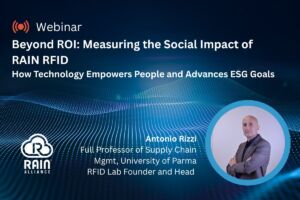
When we talk about RAIN RFID in retail and supply chains, the focus is usually predictable: efficiency, accuracy, cost savings, speed. All important, of course. But in a recent RAIN Alliance webinar, a different and far more human question took center stage:
What does this technology actually do for the people doing the work?
That question came from Professor Antonio Rizzi of the University of Parma’s RFID Lab, and it reframes how we think about success. Instead of stopping at Return on Investment, Professor Rizzi challenges us to consider something broader: People Return on Investment (PROI).
Shifting the Lens From Metrics to People
Professor Rizzi’s work mirrors the evolution of how RAIN RFID itself has been evaluated over time. In the early 2000s, his research focused on traditional economic ROI. That expanded into environmental ROI, measuring sustainability gains. Today, his focus has moved to what may be the most overlooked dimension of all: the human experience.
As he put it during the webinar:
“I encourage you to think not only about the money needed to fuel your company, not only about the environment, but also about your people. Is RFID a viable tool to improve working conditions? To improve competencies? To allow your people to better serve customers?”
It’s a simple idea—but a powerful one. And it turns out, it’s measurable.
Measuring Social Impact, Not Just Performance
To move PROI from concept to data, the RFID Lab developed a structured methodology built on two key components.
Social Net Promoter Score (Social NPS)
Inspired by the familiar customer metric, employees are asked a straightforward question:
“Based on the impact on your working conditions, how likely would you be to recommend working at a company with RFID to a friend or colleague?”
The idea for this question came from a real-world moment: a job candidate who flat-out refused to work anywhere that didn’t use RFID. For that person, the technology wasn’t a “nice to have”—it was a quality-of-work expectation.
TOPSIS Framework
To dig deeper, the team applied the TOPSIS ranking method to evaluate RAIN RFID’s impact across four dimensions:
- Empowerment – Enhanced productivity, reduced errors, and clear accountability
- Engagement – Better customer service and stronger colleague collaboration
- Enrichment – Skill development and transition from low-value to high-value tasks
- Management Control – Greater autonomy, trust, and work flexibility
What Happened in the Real World: The Intrend Study
To test the model, the RFID Lab partnered with Intrend, an Italian apparel retailer. The results were hard to ignore.
After implementing RAIN RFID, 70% of employees reported increased well-being and job satisfaction, producing a Social NPS score of 70—an exceptionally strong signal of advocacy and engagement.
Employees described a noticeable shift in how they spent their time. Manual, repetitive tasks like applying security tags or scanning barcodes were reduced, freeing them up to focus on customer service and higher-value work. RAIN RFID didn’t just make processes faster, it made jobs more meaningful.
From Case Study to Scientific Proof
These findings aren’t just anecdotal. The research has been peer-reviewed and published in the International Journal of RF Technologies, giving academic validation to the idea that RAIN RFID contributes to social sustainability—not just operational excellence.
Now, Professor Rizzi and his team are looking to scale the research. They’re inviting additional retailers—including C&A, Decathlon, and other RAIN Alliance members—to participate and help build a broader, statistically robust dataset across different retail environments.
The Strategic Takeaway
The message is clear: RAIN RFID is not merely a technology for operational efficiency—it’s a driver of employee well-being and a key enabler of ESG transformation.
As companies face increasing pressure to demonstrate social responsibility and attract talent in competitive markets, the ability to quantify people-centered benefits becomes invaluable. The question “Does your workplace have RFID?” may soon become as important to job seekers as salary and benefits.
Professor Rizzi’s work reminds us that the fourth industrial revolution, like those before it, should ultimately serve to improve human working conditions. When technology helps employees shift from “I like my job” to “I love my job,” everyone wins—workers, companies, and customers alike.
To learn more see the full webinar https://youtu.be/rHNRwb0wCsc.