RAIN technology is enabling a new generation of practical, connected solutions across countless connected industries. With close to one billion tags shipped each week, billions of tags are in active use each day, but reading these tags has historically relied on specialized hardware. The integration of RAIN RFID into consumer smartphones is opening up entirely new ways for end users and customers to engage with these tags.
In this Q&A, we explore how RAIN Alliance member Clustag is using RAIN standards to turn everyday smartphones into integrated, accessible and affordable RAIN RFID readers.
1. Tell us about Clustag, and how it is using RAIN RFID in its solutions
Clustag designs and deploys RAIN RFID solutions that help companies identify, verify, and track items automatically, without line of sight and without manual scanning. Unlike barcodes, RAIN RFID can read many items at once, even inside closed boxes or in motion, which improves speed, accuracy, and traceability in intralogistics operations.
What makes Clustag different is the combination of engineering + software + real integration. Our solutions are connected through Zentup, our middleware, which links RAIN RFID devices with customer systems (WMS/ERP) and keeps data available in real time for operational decisions. We also develop technologies like RFID‑Shield to avoid unwanted reads and increase precision, especially in high‑throughput environments
Finally, our approach is strongly R&D‑driven and collaborative: we model the customer’s workflow, define where RAIN RFID creates real impact, and build the solution with the customer – and partners – so it fits their processes and constraints, not the other way around.
2. What is Tag Inspector, and how does it work?
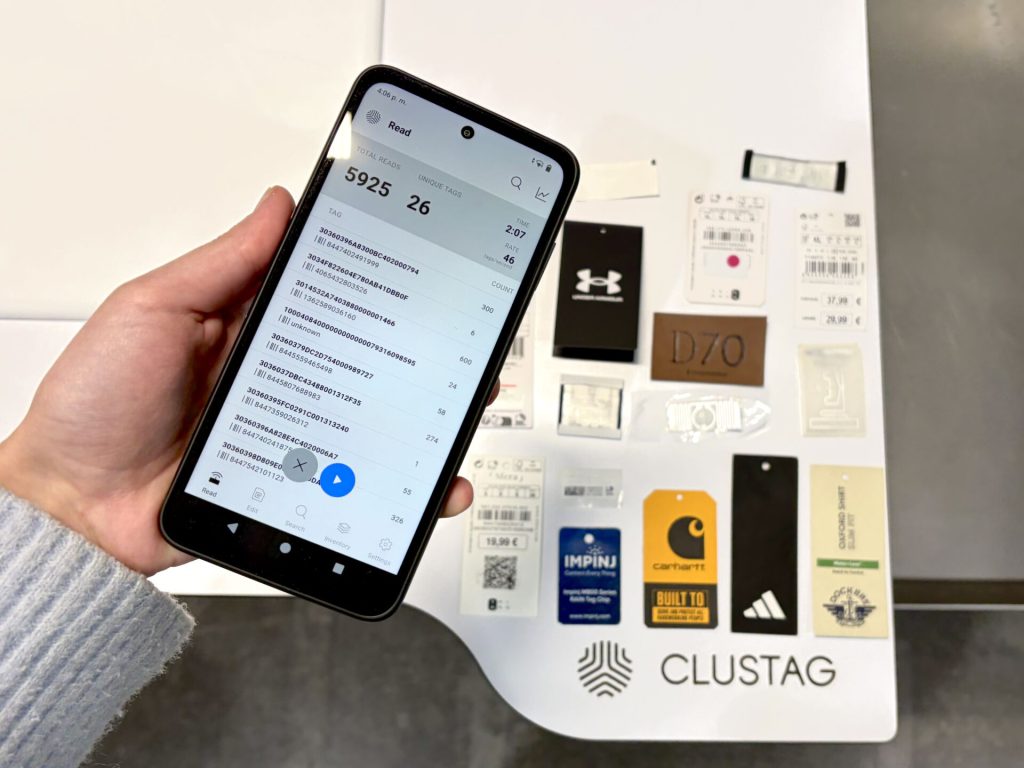
 Tag Inspector is Clustag’s application designed to help professionals quickly and accurately understand how RAIN RFID tags perform, directly from a smartphone such as the Zebra EM45‑RFID or Zebra TC53e‑RFID.
In simple terms, it turns smartphones with integrated RAIN RFID readers into powerful tools for testing, validation, and analysis, without the complexity of traditional equipment. Through a clean and modern interface, users can read, analyze, and compare RAIN RFID tags in seconds, gaining immediate insight into tag behavior in both lab and real‑world environments.
Tag Inspector provides real‑time visuals and a streamlined workflow that make it easy to validate tags, benchmark suppliers, or support technical evaluations. Users can perform reading and writing operations, EPC and barcode lookups, and visualize performance through dynamic RSSI signal charts, helping teams make confident, data‑driven technical decisions.
Developed by Clustag in collaboration with Zebra Technologies, Tag Inspector is optimized for industrial smartphones and demanding technical workflows. Guided by continuous feedback from users, the application keeps evolving with new capabilities, reflecting Clustag’s ongoing investment in R&D and its commitment to improving how RAIN RFID is tested, validated, and applied in practice.
3. What benefits do RAIN-enabled smartphones bring to the end user?
RAIN-enabled smartphones bring RAIN RFID testing and validation closer to the end user by combining professional capabilities with mobility and simplicity. When users have access to a smartphone with an integrated RAIN reader such as Zebra EM45‑RFID or TC53e‑RFID, they can perform basic but essential tasks (reading, testing, and validating RFID tags) directly from the device, without needing traditional handheld equipment.
In practical terms, this means that users can run quick reading tests, compare tag behavior, and access specific information stored in RAIN tags directly at the point of use. This is especially useful in retail environments, where teams can validate tags in store, check performance on the spot, or support technical troubleshooting without interrupting operations. Clustag has seen this approach applied in real scenarios through its collaboration with Zebra Technologies and deployments such as Tag Inspector used in major retail environments, where smartphones with RAIN readers enable fast, contextual tag testing.
At the same time, RAIN-enabled smartphones are also highly valuable in laboratory and technical environments, where engineering, R&D, or telecommunications teams need a lightweight and flexible tool to analyze tag performance, compare models, or carry out controlled validations.
By making RAIN RFID testing more accessible, visual, and immediate, solutions like Tag Inspector reduce complexity, speed up validation processes, and help users make confident, data‑driven decisions, whether they are working in store, in the field, or in the lab.
4. Why did Clustag choose to join the RAIN Alliance?
Clustag chose to join the RAIN Alliance to actively participate in the global RAIN ecosystem that promotes the adoption and evolution of RAIN RFID technology. For Clustag, RAIN RFID is more than a choice of technology. It represents our commitment to a shared framework that allows different companies, devices, and software platforms to work together.
The RAIN Alliance plays a key role in encouraging collaboration across the value chain and in ensuring interoperability through common standards. Being part of this ecosystem allows Clustag to stay closely aligned with industry developments, take part in discussions around new use cases, and collaborate with key technology partners.
It also reflects Clustag’s belief that innovation moves faster and delivers more value when it is shared, standardized, and developed together with the wider industry.
5. Why are RAIN technology standards so important to the work Clustag is doing?
RAIN RFID standards are essential because they make solutions interoperable, scalable, and futureproof. For Clustag, working with established standards ensures that its solutions can operate reliably across different devices, platforms, and environments, without limitations or lock‑in.
Standards also enable innovation without fragmentation. As new use cases emerge (such as smartphones with integrated RFID readers) standards are what make these innovations viable at scale. The RAIN Alliance has highlighted these trends as a new wave of innovation, and shared standards are what allow them to reach real‑world adoption.
By aligning its developments with RAIN RFID standards, Clustag ensures long‑term compatibility, protects customer investments, and makes collaboration with technology partners much easier when designing new applications.
6. What’s next for Clustag and its use of RAIN technology?
Clustag will continue expanding its RAIN RFID ecosystem with a strong focus on software, mobile reading, technical validation tools, and real‑world applications. Solutions like Tag Inspector will keep evolving based on feedback from users, customers, and partners, adding new capabilities that improve testing, validation, and everyday use of RAIN RFID devices.
More broadly, Clustag remains committed to applied R&D and co‑innovation. Its engineering, telecommunications, and software teams work closely with customers and technology partners to design new applications that make RAIN RFID easier to validate, deploy, and scale.
By staying actively involved in the RAIN Alliance and closely connected to industry events and innovations, Clustag ensures it remains up to date with new trends—so RAIN RFID continues to improve the day‑to‑day experience of users and delivers real, practical value.