
A single-use cup is used for minutes but takes years to break down, and the vast majority end up in landfill or incineration, not recycling. Regulation is now forcing the reuse issue: the EU’s Single-Use Plastics (SUP) directive is already in force, the Packaging and Packaging Waste Regulation (PPWR) is introducing reuse targets from 2030, and Extended Producer Responsibility (EPR) legislation in the US is holding venues accountable for their packaging waste. Reusable cup schemes are the practical response. But making them work operationally — at scale, with high return rates and verifiable data — is harder than it looks.
Venues know they need to act. Many have tried. And many early reusable cup programmes quietly failed, not because of the cups, but because of what happened after they were handed out. You can read the full case study comparisons here.
The problem with reuse is operational, not environmental
Without knowing where every cup is, how many times it has been washed, and what the real return rate is, reuse programmes are operationally blind. Manual counting is slow and error-prone. Deposit fraud is difficult to prevent. And without verifiable data, venues cannot demonstrate regulatory compliance, justify the business case, or make the decisions needed to scale.
RAIN RFID solves this by giving every cup a unique, machine-readable digital identity — one that persists through hundreds of wash cycles, links to payment transactions at the point of sale, and triggers deposit refunds automatically the moment a cup is returned. Reuse becomes trackable, auditable, and frictionless.
Five venues. Five deployments. One consistent story.
A new set of case studies from the RAIN Alliance documents how this is playing out in practice across five very different venues.
At Royal Antwerp Football Club in Belgium, the STAR platform developed by Aucxis processes match-day cup volumes that would overwhelm any manual system. RAIN RFID-embedded cups are scanned in bulk at return stations — even large stacks simultaneously — with deposit refunds triggered automatically to the original payer’s payment method. The result: a 98% cup return rate, more than 1 million disposable cups replaced per season, and 7 tonnes of plastic waste eliminated — all while reducing cleanup effort by 75%.
In Portland, Oregon, Bold Reuse partnered with Avery Dennison to bring item-level RAIN RFID tracking to two major sports venues — the Moda Center and Providence Park. Around 15,000 cups were tagged with Avery Dennison’s purpose-built wash-durable tags, engineered to survive up to 1,000 industrial wash cycles without losing read performance. The pilot is generating the operational intelligence that Bold Reuse needs to scale its reuse network nationally: precisely where cups are lost, how user behaviour affects return rates, and how to optimise the wash hub between events.
At the Eden Project in Cornwall — a botanical garden attracting around one million visitors a year — Re-Universe solved a problem that had undermined earlier programmes: the return process was too slow. Customers simply wouldn’t wait. Standalone reverse vending machines with embedded RAIN RFID readers changed that, delivering deposit refunds before a visitor steps away from the machine. The RAIN RFID tags embedded in every cup are supplied by Avery Dennison, engineered for food contact compliance and rated to withstand hundreds of wash cycles. The numbers speak for themselves: 220,000 cups kept out of landfill annually, 12.7 tonnes of CO₂ avoided, and £25,000 saved on single-use cup costs in 2024 alone. Each cup breaks even against single-use costs after just 10 uses.
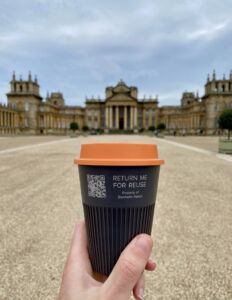 Blenheim Palace, a UNESCO World Heritage Site in Oxfordshire, tells a similar story with an even sharper commercial edge. The Re-Universe and Mastercard Move-powered scheme – with Avery Dennison supplying the RAIN RFID tags embedded in every cup – cut single-use cup spending by 50% in year one, kept 320,000 cups out of landfill over 12 months, and reduced carbon emissions by 1,150 kg. Each reusable cup breaks even after just four uses against a single-use alternative costing £0.35–0.67. Visitors noticed: the cups are specifically mentioned in satisfaction surveys as evidence that the estate’s environmental values are genuine.
Most recently, Imperial College London launched a six-month trial at The Roastery, one of its South Kensington campus cafés, working with Re-Universe and Avery Dennison to remove single-use cups entirely from the outlet. The Roastery alone issues around 55,000 disposable cups a year. The RAIN RFID system links every cup to the customer’s payment transaction at the counter, and near-instant card-tap refunds at the automated return station make handing a cup back the path of least resistance. Early results: 55,000 cups displaced, 1,210 kg of waste saved, and 2,513.5 kg of CO₂ avoided. If successful, Imperial intends to expand across all campus outlets and into food containers.
What these five cases have in common
The venues could hardly be more different — a football stadium, two sports arenas, a botanical garden, a heritage estate, and a university campus, across three countries. But the experience across all five is consistent.
RAIN RFID is what makes the economics work. Reusable cups are only cost-competitive if they are actually returned, washed, and reused at high rates — and high return rates require frictionless experiences. Near-instant deposit refunds, delivered by RAIN RFID readers before a customer walks away, are the design principle that makes this work. Every deployment that has removed friction from the return process has seen return rates that would be impossible to achieve with manual or slower digital alternatives.
RAIN RFID is also what makes compliance credible. The EU SUP directive, PPWR reuse targets, and EPR frameworks all require verifiable data on reuse rates and waste diversion. Manual processes cannot provide this at scale. The item-level audit trail generated automatically by RAIN RFID can, and increasingly, it is the foundation on which regulatory reporting, ESG disclosures, and sustainability claims are being built.
Read the full case studies to explore how RAIN Alliance members are making RAIN RFID-enabled reuse a commercial and operational reality across stadiums, visitor attractions, and campuses.