
By Paul Muller, RAIN-enabled Smartphone Leader, RAIN Alliance
Over the past few months, through conversations and presentations at RAIN in Action, Wireless IoT Tomorrow, the IEEE World Forum on IoT, and our recent RAIN Alliance The Future of Retail webinar, I’ve been struck by how consistently the same themes are emerging across the industry. Retailers, technology providers, and solution integrators are converging on a common understanding: retail is steadily evolving into an environment defined by continuous, item-level awareness.
What makes this moment so compelling is that the transition is not arriving through a single disruptive leap. Instead, it is unfolding through a series of practical, mutually reinforcing advancements—more precise identification, more accessible sensing, better data interpretation, and new pathways for consumers to engage with products directly.
At the center of this progression is RAIN technology, now extending into everyday devices through the first generation of RAIN-enabled smartphones beginning to enter production, and contributing to the industry’s development of more ambient and digitally connected product environments. Together, these developments point toward a more connected, more responsive retail ecosystem.
At the center of this progression is RAIN technology, now extending into everyday devices through the first generation of RAIN-enabled smartphones beginning to enter production, and informing the industry’s exploration of more connected, increasingly ambient product environments. Together, these developments point toward a more connected, more responsive retail ecosystem.
RAIN Technology and the Rise of Item-Level Intelligence
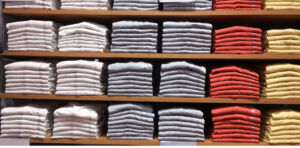
RAIN RFID entered retail as a solution to the persistent challenge of inventory inaccuracy. Many retailers were operating with data that could not reliably support modern omnichannel services. By introducing item-level identification, RAIN technology helped lift accuracy into the 95%+ range, enabling retailers to manage their products with far greater clarity.
The more significant development, however, has been the realization that RAIN technology provides something deeper: a persistent digital identity for every product. This identity moves with the item across the supply chain, into the store, through the fitting room, and even into repair or resale channels. It enables new forms of operational awareness—awareness that influences availability, productivity, planning, and customer experience.
During our Future of Retail webinar, Hervé d’Halluin of Decathlon captured this evolution succinctly:
“Customer experience starts with availability.”
Availability requires more than accurate counts. It requires adaptable, real-time understanding of where items are and how they move. For companies like Decathlon, long-term adoption of RAIN technology has created rich historical records of item movement and lifecycle status, providing insight that supports replenishment, sustainability initiatives, repair programs, and other operational decisions.
Bill Toney of Avery Dennison expressed a similar perspective:
“Serialized RAIN RFID didn’t just give retailers better data—it changed how they run their businesses.”
This shift, from data collection to operational transformation, is now becoming industry-wide.
Toward More Responsive Retail Environments
With item-level identity becoming standard in many categories, retailers are integrating RAIN technology with complementary systems to create more responsive store environments.
Overhead readers, robotics, computer vision, and predictive software are being deployed in ways that make the store more aware of its own state. The goal is not full automation, but more consistent, timely insight. When merchandise movement is visible in real time, replenishment can happen earlier, merchandising decisions can reflect actual conditions, and loss can be investigated with greater precision.
This has implications for store associates as well. Across industry discussions, one theme surfaced repeatedly: better information improves the quality of people’s work rather than replacing it. As Ted McCaffrey of GreyOrange remarked:
“This isn’t about replacing people—it’s about equipping them. It kind of transforms associates from searching to serving”
In responsive environments, associates spend less time searching for items, validating stock, or managing point of sales, and more time focusing on service, selling, or specialized tasks that rely on human judgment.
 RAIN-Enabled Smartphones: A New Interface for Item Awareness
 RAIN-Enabled Smartphones: A New Interface for Item Awareness
One of the most meaningful developments underway is the integration of RAIN RFID reading capabilities into smartphones. Qualcomm has integrated RAIN technology into one of its latest mobile processors, marking an early but important step toward making item-level intelligence accessible through everyday devices.
This shift will broaden who can interact with RAIN-tagged items—and how.
Once these phones reach commercial availability, both associates and consumers will be able to:
- Locate products quickly
- Complete purchases without traditional scanning
- Access care, sustainability, or authenticity information
- Interact with items post-purchase in ways that enhance usability
As I shared during my IEEE World Forum on IoT 2025 remarks:
“Once consumers can interact with physical products as easily as they interact with digital content, the boundary between online and in-store experience begins to dissolve.”
The introduction of RAIN-enabled smartphones will not overturn retail overnight, but it will steadily reshape how people access and use information about the products around them.
A Gradual Expansion Into the Home
Parallel to developments in stores, item-level intelligence is beginning to surface in the home. Although many of the most advanced use cases are still emerging, the underlying capabilities are increasingly practical.
RAIN-connected items can support everyday tasks such as:
- Managing food freshness or medication safety
- Helping appliances select appropriate care cycles
- Supporting packing and travel organization
- Tracking commonly used or borrowed items
These scenarios resonate because they align with real consumer routines. And with RAIN-enabled phones, households will have a built-in interface for interacting with tagged items without requiring additional devices.
Policy initiatives such as the EU’s Digital Product Passport—which calls for persistent product identifiers across the product lifecycle—reinforce this trend toward more durable, interoperable product data.
A More Complete Picture Through Sensor Fusion
Across the industry, we’re seeing increasing emphasis on combining RAIN technology with other sensing technologies to create a fuller view of retail environments. Each technology offers unique strengths:
- RAIN technology provides reliable item identity
- Computer vision adds spatial and contextual understanding
- Bluetooth Low Energy and other wireless signals support indoor navigation and consumer engagement
- AI and edge analytics interpret the combined signals in real time
The value comes not from replacing one system with another but from combining them to address different types of information needs.
This thoughtful integration is enabling a more complete understanding of the physical world; bringing greater clarity to how products, assets, and materials move through the environments we rely on every day.
Looking Ahead
Across the conversations, presentations, and deployments seen throughout the last few months, several themes consistently emerge:
- Retail stores and operations are shifting from periodic measurement to continuous awareness.
- The earliest RAIN-enabled smartphones will expand access to item-level information.
- Products will carry persistent digital identities that remain relevant far past the point of sale.
- Our homes will gradually adopt practical elements of ambient awareness, extending the value of our items’ digital identities into everyday activities.
- Decision-making will increasingly rely on more complete, item-level histories rather than assumptions.
This is not a sudden transformation. It is a steady, deliberate progression toward a more connected retail landscape—one in which physical products and digital information work together seamlessly.
RAIN technology sits at the center of this evolution, providing the identity layer that makes broader connectivity possible.
As we look toward 2026, one of the most important opportunities to continue this conversation will be at NRF in New York this January. NRF brings together leaders from across retail technology, supply chain, operations, and emerging IoT ecosystems, making it an ideal setting to explore how RAIN technology, item-level intelligence, AI and edge analytics are shaping the next era of connected commerce. Aileen Ryan, President of the RAIN Alliance, will be attending NRF, and we encourage anyone interested in discussing these trends, or in learning more about the work we’re doing across the RAIN ecosystem, to reach out and connect with her during the event.