
What RAIN RFID tags are made of, how they work, and what happens to them inside paper, plastic, and textile recycling streams
Billions of RAIN RFID tags are deployed every year — sewn into garments, built into reusable containers, and applied as labels to boxes — giving everyday products the digital identity that reuse systems, recycling sorting lines, and the Digital Product Passport increasingly depend on. Every one of those tagged products will eventually reach the end of its life.
So it is worth following the tag on that journey: what it is made of, how it works, and what happens to it inside the recycling streams its products enter.
A chip, an antenna, and not much else
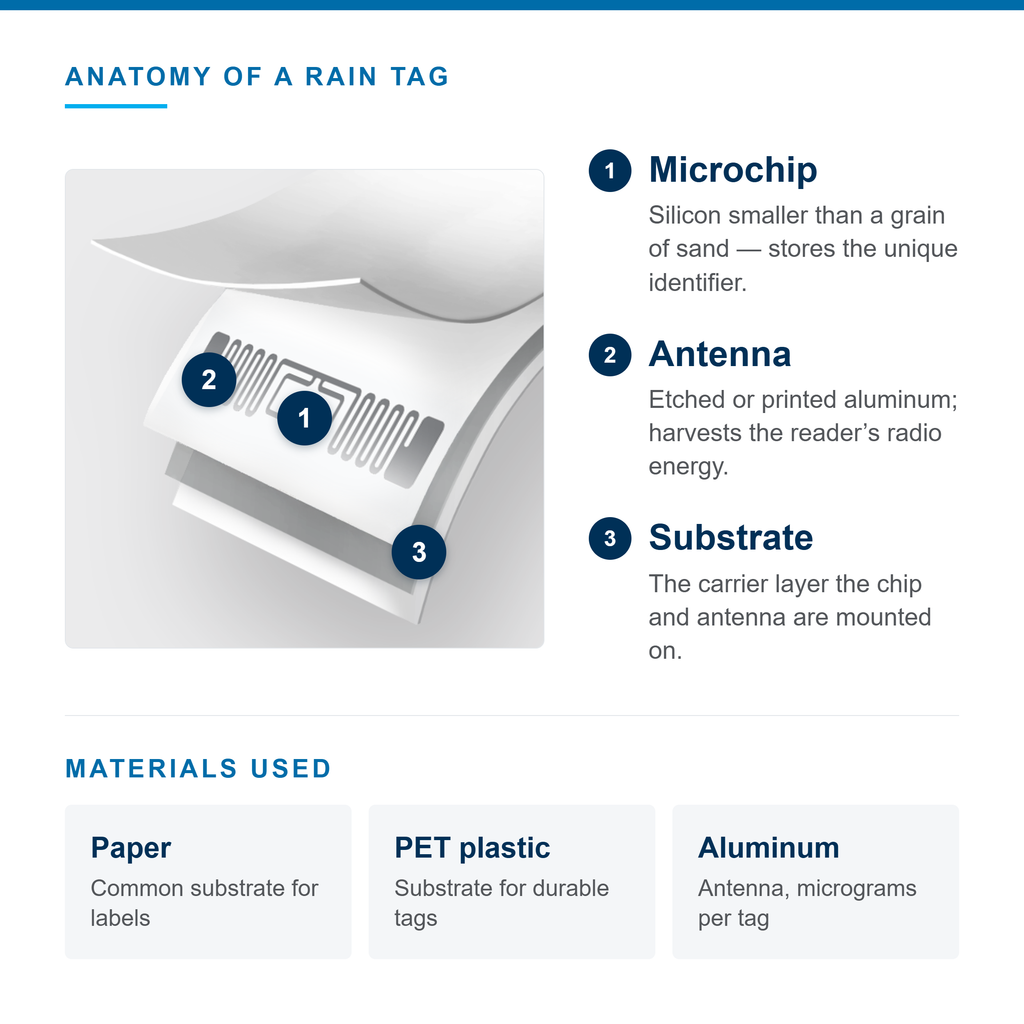
A RAIN tag consists of a silicon chip smaller than a grain of sand, a thin antenna, and a paper or film substrate, typically weighing less than a gram in total. Each of those three parts has a specific job. The chip stores the product’s unique identity; essentially, a serial number for the physical world. The antenna, made from aluminum, copper, or printed conductive ink just microns thick, captures the radio signal from a nearby RAIN reader. The substrate holds everything together, whether as a paper label on a shipping box or a thread sewn into a garment seam.
The way the tag communicates is part of its elegance. A RAIN tag has no battery and does not transmit on its own. When a RAIN reader’s radio signal reaches it, the tag draws just enough energy from that signal to wake its chip and reflect the signal back, subtly altered to carry the product’s identity. The tag speaks only when spoken to, using borrowed energy, and then falls silent. That is how RAIN tags can be read by the thousands per second, through fabric and packaging, with no wires, charging, or maintenance.
That simplicity carries through to the materials. Where powered devices bring batteries, circuit boards, displays, and casings, a RAIN tag travels light: three basic components weighing less than a gram, attached to a product that typically weighs much more. In material terms, it has more in common with a printed label than with the electronics the word “chip” might suggest. And that lightness suits it to circularity: a tag simple enough to be built into a cup base or sewn into a seam can travel with its product through washing, sorting, and recycling processes.
Following the tag through the loop
Each recycling stream asks something different of a tag. A paper mill turns boxes back into fiber. A PET plant grinds bottles into flake and washes them clean. A textile recycler shreds garments and spins the fibers into new yarn.
Researchers across three continents have sent RAIN-tagged products through all three processes and followed the tag and its components to the end.
Paper and cardboard
Corrugated recycling is one of the world’s most established recycling industries, and it already handles enormous volumes of RAIN tags. Smurfit Westrock, one of the largest recyclers in the U.S., recently counted more than a million RAIN RFID labels flowing through a single mill in just a few months.
In 2024, the company partnered with Western Michigan University’s paper pilot plant to follow those labels through the repulping process. The findings were encouraging: the labels separated cleanly from the fiber and were collected from the pulper, recovered-paper samples showed no detectable residual metals, and the researchers concluded that smart tags had no notable impact on corrugated box recyclability.
Plastics
Inside a PET recycling plant, bottles are ground into flake and washed — a process designed to separate labels and adhesives so the plastic emerges clean. RAIN RFID labels have been engineered for this environment, and the recycling industry’s own certification bodies have validated some of those designs. An Avery Dennison label became the first RFID label to earn APR Design® for Recyclability recognition in North America and RecyClass Technology Approval in Europe. The RAIN Alliance’s Plastic Packaging Tiger Team has also published a shared, vendor-neutral roadmap to help a growing family of tags earn the same recognition.
Textiles
Apparel is making one of the most significant shifts in how RAIN tags are used: moving from removable hangtags to durable tags woven into the garment itself, designed to stay with the product for its entire life.
That same durability makes RAIN a leading candidate for the data carrier in the Digital Product Passport. And the recycling evidence is keeping pace. The French textile research center CETI took 100 kilograms of cotton garments with Primo1D tags sewn into the seams and ran them through a complete mechanical recycling chain: cutting, fraying, blending, carding, spinning, and knitting. The tagged garments performed alongside untagged garments. Fiber quality was comparable, blends containing up to 70% recycled content were spun into yarn that met industrial quality thresholds, the finished fabric showed no visible trace of the tags, and the yarn passed the most stringent toxicological standard available.
The results from chemical recycling were just as encouraging. In a study with CuRe Technology, polyester garments with embedded RAIN tags went through a depolymerization process. High-quality, near-white monomers emerged, while the tag components were removed through standard filtration. The recycled polyester matched virgin material, including its melting point.
And the design trajectory continues. As compostable packaging becomes a recovery category of its own, tag design is moving in that direction too. Compostable, ink-based inlays are being developed with antennas printed from nano-copper inks directly onto paper, replacing the plastic substrates and etched metals used in conventional tags. The goal is for these tags to biodegrade alongside the materials they accompany. When packaging is destined for the compost pile rather than the recycling stream, its digital identity can be designed to go with it, extending item-level identification into yet another recovery pathway in a circular economy.
A designed-in part of circular systems
Across paper, plastics, and textiles, purpose-designed RAIN tags have been tested by universities, recognized by the recycling industry’s own certification bodies, and are already shipping in commercial products.
And the technology’s overall environmental contribution points in the same direction. University of Parma lifecycle research found that deploying RAIN RFID can reduce global warming potential by roughly 30% in the real-world supply chains studied, driven by lower product shrinkage, fewer missing or expired products, and less transportation caused by shipping errors.
The picture that emerges is of a technology designed for the loop it serves: tags engineered for individual recycling streams, tested by universities, recognized by the recycling industry’s own certification bodies, and continuing to evolve toward printed antennas, paper substrates, and compostable constructions.
Join the RAIN Alliance in building the circular infrastructure
The RAIN Alliance and its member companies are investing early and deliberately: pursuing formal recyclability recognition, publishing guidance, and engineering a new generation of inlays with the full product lifecycle, end of life included, as a core design specification. The RAIN community is working hand in hand with recyclers, sorters, and certification bodies to keep it moving: aligning on the data end-of-life operators need, testing, publishing, sharing. There is real work ahead — bringing textile recycling to commercial scale, and extending certified tag designs across more streams — and it will take the whole ecosystem. We warmly invite recyclers, brands, and technology providers to join. The circular economy is being built on shared infrastructure and shared evidence, and there is room in the loop for everyone.