
 The core premise of this article is a fundamental paradigm shift: RAIN RFID has transitioned from isolated hardware challenges to an enterprise-integration imperative. In 2026, the question is no longer “Does RAIN RFID work?” but rather “How effectively can we scale and integrate RAIN RFID data across our entire supply chain?”
- The Core Strategic Shift
Point Solutions & Silos ───► Connected Data Ecosystems
(Inventory counts, loss prevention) (Actionable insights, lifecycle tracking)
Early deployments treated RAIN RFID as an isolated data collection tool. Today, driven by regulatory demands (like Europe’s Digital Product Passports and the Falsified Medicines Directive) and consumer expectations for transparency, RAIN RFID is a core business intelligence enabler. Organizations must now answer complex lifecycle questions and be able to trace products “one up” (to buyers) and “one down” (to suppliers), while also providing detailed item information such as country of origin, environmental footprint, and disposal and recycling guidelines.
- The Functional Components of an RAIN RFID Ecosystem
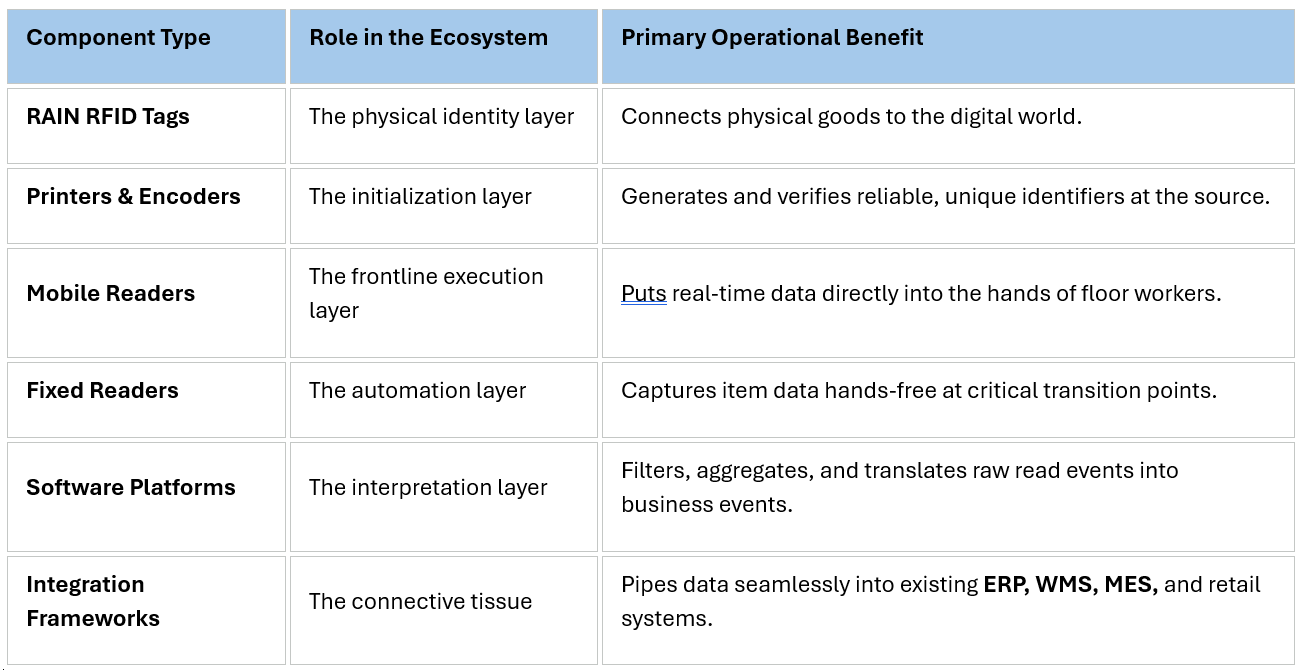
To move past isolated “siloed” visibility and achieve enterprise-scale automation, an organization cannot rely on hardware alone. It requires a synchronized infrastructure across six layers:
How TSC Auto ID Supports Connected RAIN RFID Ecosystems
At TSC Auto ID, we see this evolution reflected in customer projects across retail, logistics, manufacturing, and healthcare environments. Organizations are increasingly looking for partners that can support every stage of the RAIN RFID journey—from tag encoding and label printing to mobile data capture, fixed infrastructure, and enterprise integration.
By combining RAIN RFID printers and encoders, mobile computing devices, RAIN RFID infrastructure, and integration capabilities, TSC helps bridge the gap between data capture and operational execution. The goal is not simply to collect more data, but to ensure that RAIN RFID information can flow seamlessly into ERP, WMS, MES, and retail systems where it can support real business decisions.
This approach aligns with a broader industry shift away from standalone products and toward connected ecosystems that deliver visibility, traceability, compliance, and long-term operational value.
- Key Pillars for Successful Scaling
- Prioritize Open Standards: Proprietary lock-in is a barrier to scale. Modern deployments must rely on open standards from GS1 and ISO to ensure data can move seamlessly between disparate systems and external supply chain partners.
- Treat Hardware as an Integration Project: Successful implementations are looked at through the lens of a broader digitalization strategy rather than a simple hardware rollout.
- Shift Vendor Expectations: Organizations are moving away from component vendors and aligning with solution enablers that can provide the technologies, expertise, integration capabilities, and partner ecosystems required to support RAIN RFID at scale. TSC Auto ID’s strategy reflects this shift, combining RAIN RFID, mobile computing, printing, and software integration into a unified solution approach.
The Bottom Line for 2026 and Beyond: The future of RAIN RFID belongs to organizations that can integrate RAIN RFID data into their enterprise systems while maintaining flexibility to support future applications. Those that build connected, scalable RAIN RFID ecosystems will successfully convert compliance and traceability into a distinct competitive advantage.