
The RAIN RFID Retail Maturity Journey
Retail has always been defined by its ability to adapt. Over the past several decades, retailers have continually evolved in response to changing consumer expectations, new business models, and emerging technologies. Stores became omnichannel fulfillment centers. Digital commerce blurred the boundaries between physical and online shopping. Data transformed merchandising and marketing, while sustainability and transparency became strategic priorities rather than niche initiatives. Today, artificial intelligence promises to reshape everything from demand forecasting and inventory planning to customer engagement and workforce optimization.
Although these developments are often discussed independently, they are all part of a broader transformation. Retail is becoming an increasingly information-driven business, where competitive advantage depends not simply on having more data, but on having better information about what is happening throughout the enterprise. The ability to understand where products are, how they move, and how they interact with customers and operations is becoming just as important as the products themselves.
For much of retail’s history, however, that understanding has been incomplete. Inventory records have represented estimates rather than certainty, updated periodically through manual counts or barcode scans that capture isolated moments in time. Store associates have spent valuable hours searching for merchandise that systems indicated should be available, while merchants and supply chain teams have often made decisions using information that no longer reflected reality. Retail has become remarkably sophisticated despite operating with an imperfect understanding of its own physical operations.
The next chapter of retail will be shaped by closing that gap.
A Common Language for a Shared Journey
Retailers around the world are adopting RAIN RFID to solve a wide range of business challenges. Some organizations begin with periodic inventory counts to improve inventory accuracy. Others deploy RAIN RFID to improve loss prevention, strengthen supply chain visibility, or support broader digital transformation initiatives. Increasingly, retailers are also exploring how trusted item-level information can support emerging priorities such as Digital Product Passports, authenticated resale, sustainability reporting, and business intelligence.
Every retailer’s business case is different.
Yet despite these different starting points, successful RAIN RFID deployments tend to follow a remarkably consistent pattern. As deployments expand and mature, retailers gain richer visibility into products and operations, unlock new capabilities, and create opportunities that often extend far beyond the objectives that justified the initial investment.
Recognizing this progression, the RAIN Alliance developed the RAIN RFID Retail Maturity Model.
The model provides a framework for understanding how organizations progressively build capabilities through trusted item-level intelligence. It illustrates how retailers evolve from improving operational efficiency to enabling enterprise-wide visibility, traceability, and intelligent decision-making and how each stage creates the foundation for the next.
Whether an organization is evaluating its first deployment or scaling an established implementation, the model provides a common language for understanding retail maturity. It helps retailers assess where they are today, identify the capabilities that typically emerge next, and build a roadmap for continued innovation.
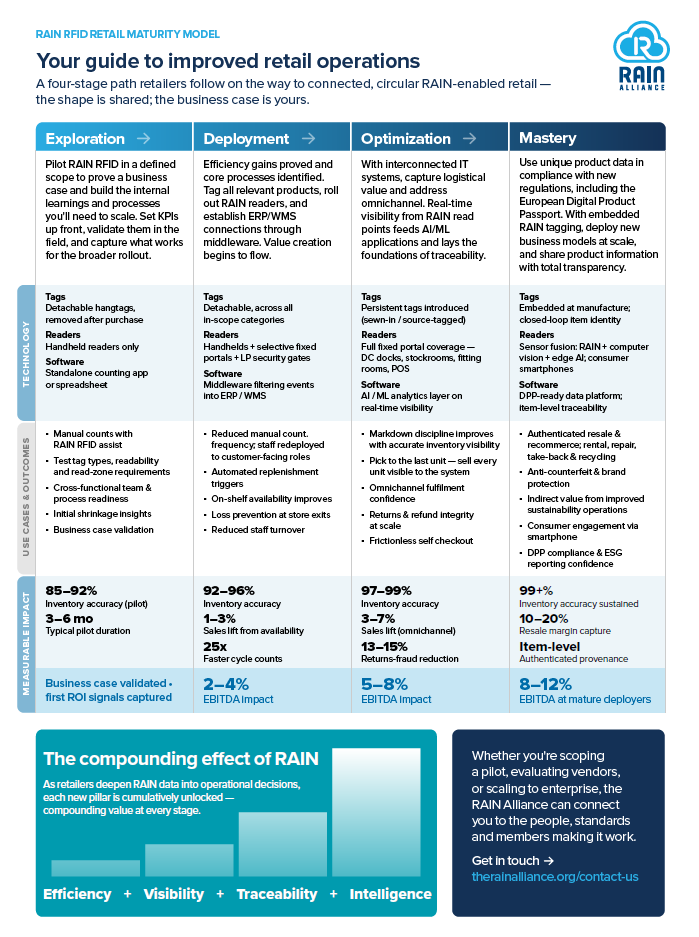
The model shows how technology, capabilities, and measurable outcomes evolve together as retailers move through each stage.
As Deployments Mature, Value Grows
Retailers with more mature RAIN RFID deployments often describe the same thing: the value keeps growing. The more of a retailer’s operations that runs on RAIN technology — more items tagged, more readers deployed, more workflows integrated — the more use cases, outcomes, and business impact become possible.
The value shows up in different ways at each stage. Early on, it looks like efficiency — hours reclaimed from manual counting, inventory records that finally match reality, associates freed up for the sales floor. As deployments deepen, real-time visibility changes operations and what’s possible: fewer stockouts, sharper replenishment, loss prevention that catches what used to walk out the door. Deeper still, item-level traceability enables new customer experiences and unlocks entirely new opportunities — Digital Product Passport compliance, authenticated resale that gives products a second life, product histories a shopper can scan on their phone, provenance the brand can stand behind. And at full maturity, retailers unlock a kind of business intelligence that simply wasn’t available before — decisions made on trusted data, patterns visible for the first time, opportunities the earlier stages of the journey couldn’t have surfaced.
The four pillars of efficiency, visibility, traceability, and intelligence describe what accumulates as deployments mature. Each additional investment in the deployment — more items tagged, more readers deployed, more workflows integrated — expands the use cases, deepens the outcomes, and grows the measurable impact on the business.
The Foundation Retail Will Run On
The retail industry is entering a decade in which product-level truth stops being a nice-to-have and becomes a working condition. AI systems will make decisions the business acts on, and those decisions will only be as good as the data underneath. Regulators, customers, and partners will increasingly ask retailers to prove what they claim about the products they sell. New business models — resale, rental, repair, take-back — will succeed or stall based on whether a retailer can maintain a trusted connection to individual items.
The RAIN RFID Retail Maturity Model describes the shape of that transformation. It shows how each stage builds on the one before it and how the value of RAIN compounds as retailers move up the curve. It is a shared reference point the industry can use to see where deployments sit today, what capabilities emerge next, and how each investment sets up the ones that follow.
The shape of the journey is often very similar across the industry. The pace, the priorities, and the starting point are the retailer’s own. What matters, in the end, is the trusted foundation that gets built along the way. That foundation of trusted RAIN data is what tomorrow’s retail will run on.
Acknowledgments
The RAIN RFID Retail Maturity Model was developed through the collaborative efforts of the RAIN Alliance and its member community. The Alliance extends its sincere appreciation to Pareiya Gupta Director of Product Innovation and Corporate Development at gStore and Tristan Finet, RFID & Traceability Program Support Manager at Decathlon for sharing their expertise, operational insights, and practical experience, which helped shape the framework and ensure it reflects the realities of modern retail.