
The pharmaceutical industry has long faced challenges of counterfeit, adulterated, or expired drugs entering the supply chain. Fake versions of popular drugs like Ozempic® (a registered trademark of Novo Nordisk A/S), oxytocin, and others routinely make their way to consumers outside of the manufacturer’s authorized supply chain. These threats not only undermine consumer trust but can pose significant safety risks to patients.
The Axia Institute at Michigan State University recently completed its Pharma End-to-End RFID Pilot Phase 2, testing the feasibility of RAIN Radio-Frequency Identification (RFID) technology for traceability of pharmaceutical products through the supply chain.
Phase 2 Achieves 100% Traceability
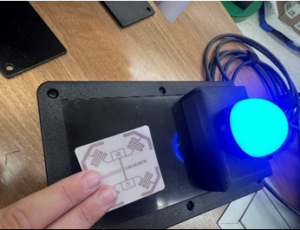
RAIN RFID tags were applied to each pharmaceutical unit before they entered the real-world test. RAIN RFID tags provide a more secure pharmaceutical supply chain while keeping patients safer.
Phase 2 achieved 100% traceability across a simulated real-world supply chain, demonstrating the robustness and interoperability of RAIN RFID across the pharmaceutical supply chain. The study, aligned with GS1 standards and the U.S. FDA’s Drug Supply Chain Security Act (DSCSA) requirements, collected data from RAIN RFID readers at key locations and uploaded the data to a cloud-based Observer Platform developed by Axia. Phase 1, completed in October 2023, demonstrated the technical feasibility of applying RAIN RFID to various drug formulations and pharmaceutical packaging types in a lab setting.
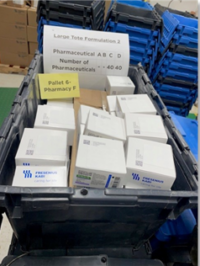
A new order of pharmaceuticals is received at a “pharmacy,” the last distribution point in the real-world pilot.
Phase 2 is the first comprehensive initiative to use GS1’s global interoperable standards to evaluate the scalability and real-world applicability of RAIN RFID technology in achieving end-to-end traceability within the pharmaceutical supply chain. Both Phase 1 and 2 were conducted in collaboration with partners of Axia’s Health Consortium—including leading drug manufacturers, distributors and technology providers. Industry partners participating in Phase 2 included: Barcoding Inc., Cencora, CCL eAgile, Fresenius Kabi, GS1 US, and IntelliGuard.
Other outcomes included:
- Real-time error detection and correction, with 20 exceptions identified and resolved instantly.
- Validation of RAIN RFID’s scalability in mixed-product handling environments (cardboard packaging, glass vials).
- Integration with ERP systems, enabling automated reconciliation of shipments and inventory.
Phase 3 Planning Underway
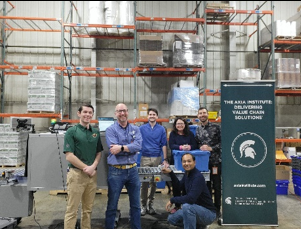
Photo credit: Cencora. The Pharma Pilot Phase 2 team at Cencora at their facility in Williamston, Mich. Pictured (left to right): Sean Murphy (Cencora), Aaron Sundman (CCL eAgile), Jack Stewart (CCL eAgile), Bahar Aliakbarian (Axia), Ethan Claucherty (Axia) and Vasu Saladi (Cencora).
As the pharmaceutical industry moves toward full DSCSA compliance, Axia’s work provides a clear roadmap for RAIN RFID adoption. Phase 3 will focus on extending RAIN RFID integration to hospitals and enabling item-level traceability up to the patient. While most collaborators from Phase 2 have agreed to continue for Phase 3, Axia welcomes new stakeholders, especially members of RAIN Alliance.
The full paper, “Feasibility of Using RAIN RFID to Enhance DSCSA Phase 2 Pilot” is available to download at https://axia.msu.edu/axia-wpd/.
About the Axia Institute

Bahar Aliakbarian, Interim Director, The Axia Institute.
The Axia Institute®, part of Michigan State University’s Office of Research and Innovation, is a premier value chain innovation center based in Midland, MI. Through applied research, industry collaboration, and education, Axia develops sustainable solutions for healthcare, food, and advanced manufacturing sectors. Its Axia Lab™, accredited by the ANSI National Accreditation Board, specializes in RFID testing and has pioneered the first globally accepted grading system for healthcare RFID tags.