

By Aileen Ryan, President, RAIN Alliance
Three days in Madrid. Nearly 600 attendees and our largest gathering ever. Here’s what the week told me about where the RAIN ecosystem is heading.
Walking away from Madrid, one thought kept coming back to me: the conversation around RAIN technology has fundamentally changed.
For years, our community has focused on explaining what RAIN RFID is — the physics, the protocol, the deployment considerations. In Madrid, nearly 600 of us came together for three days of case studies, keynotes, workshops, and demos, and the shift was unmistakable. We weren’t just talking about what the technology is. We were talking about all that it can do, the impact it is already having, and the size of the opportunity that lies ahead.
Here are the six takeaways from this year’s RAIN in Action that stood out to me.
From Identification to RAIN Sensing

RAIN RFID has always been about identification. In Madrid, it became clear to me that it is also increasingly about RAIN Sensing, a capability already built into the ISO 18000-63 standard.
We saw battery less RAIN Sensing embedded inside moving escalator handrails, generating a continuous data stream for a seven-year service life without a single battery change. We heard about RAIN-enabled orthopaedic implants that can flag infection, monitor strain, and detect abnormal behaviour long after a patient leaves the hospital. We saw sensing applications in industrial consumables, connected medical devices, and more.
What struck me was the breadth of what is already underway across the industry. Pharmaceutical companies are embedding temperature and humidity sensing inside blister packs to confirm vaccines and biologics are reaching patients in viable condition. Food producers are using freshness and moisture sensing at the item level to reduce spoilage and extend shelf life. Tyre manufacturers are tracking pressure and condition across the lifecycle of each tyre, supporting both safer operation and the EU’s upcoming Digital Product Passport requirements. And construction teams are embedding RAIN Sensing inside concrete to monitor curing and long-term structural integrity from the moment it is poured.
Taken together, these use cases point to a fundamental expansion of what RAIN RFID can do. It is no longer only identifying items, it is reading the world those items live in. The RAIN Alliance Sensors Workgroup will soon be publishing RAIN Sensing technical foundations and emerging applications in detail.
From Either/Or to And

For years, the technology conversation has often been framed as a competition. RAIN RFID or Barcodes. Optical or RAIN RFID. RAIN or NFC. One winner, one loser.
Madrid pushed back on that framing and raised an interesting question for me.
What becomes possible for our ecosystem when RAIN RFID is combined with complementary technologies, rather than positioned against them?
The clearest example came from Amazon. In their session on frictionless retail checkout, we saw how combining RAIN RFID with AI and computer vision is producing an experience that none of those technologies could deliver on their own. It wasn’t a case of RAIN RFID replacing optical or vision or vice versa, it was a case of each technology doing what it does best, with the whole becoming far more than the sum of its parts.
Across the week, examples kept surfacing of RAIN RFID being paired with NFC, BLE, optical sensing, and battery-free sensing to solve problems that none of them could crack alone. There is real exploration still to do in this space, and I believe it may be one of the most interesting areas for our industry to lean into together.
From RAIN RFID Data to the Backbone of Physical AI
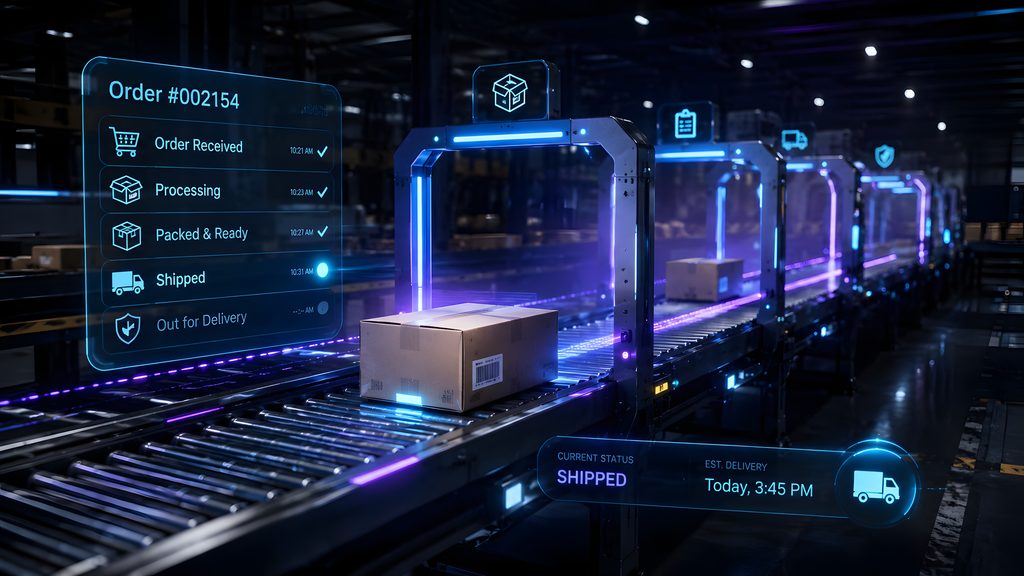
Across almost every track, AI showed up, not as a buzzword, but as a practical multiplier. We heard about AI-driven inventory decisions in retail, automated sorting at end-of-life for circularity, pharmaceutical supply chain intelligence, and frictionless checkout experiences. In each case, AI is turning the item-level data RAIN RFID generates into something far more valuable than visibility alone.
Amplifying a key message from my own opening keynote, we heard over and over that AI is only as good as the data it is trained on. And when it comes to the physical world — real items, real locations, real movements — RAIN RFID is increasingly the source of that truth.
That reframes our industry’s value in a meaningful way. RAIN RFID is not just a technology that enables visibility and efficiency; it is the trusted data backbone that makes AI in the physical world possible at all. It is the truth that allows AI’s outputs to be trusted, audited, and acted upon. Our community has always talked about the value and benefits RAIN RFID enables. What is new is that RAIN RFID is now foundational to how AI understands and acts on the physical world.
From Vision to Reality: The RAIN-enabled Smartphone

If one topic generated more energy at RAIN in Action 2026 than any other, it was the RAIN-enabled smartphone.
For years, RAIN-enabled smartphones has been a vision — something we have talked about in future tense. In Madrid, it moved firmly into the present tense. Working demonstrations in the RAIN Experience Lab let attendees pick up devices and see RAIN RFID running natively on consumer hardware. Pre-conference workshops dug into the user experience, the developer requirements, and the smartphone OS integration work that is actively underway. Keynote sessions walked through hardware abstraction layers, standardized developer APIs, and the native OS discovery that will allow RAIN RFID to operate the way NFC, BLE, and Wi-Fi do today.
The excitement in the room was palpable, and for good reason. Once RAIN RFID sits natively on consumer devices, nearly every use case we talked about across the week — Digital Product Passports, consumer traceability, authentication, in-store engagement, circular commerce — gains an entirely new channel that reaches directly into billions of people’s pockets. It is a step change for our industry, and Madrid was the moment when the path from vision to reality became genuinely visible.
From Industry Progress to a Stronger Collective Voice

Another thing that stood out to me in Madrid was how much the RAIN Alliance’s role has evolved alongside the industry. For the first time, government affairs had a place on the RAIN in Action agenda, a meaningful sign of how these conversations have become part of our community’s work.
It was never enough for the RAIN Alliance simply to grow. As our membership grows, so does the Alliance’s voice and capacity to make an impact. A stronger membership base allows us to invest in the expertise, government affairs support, and advocacy needed to represent the industry effectively. From engaging with policymakers on Digital Product Passports and e-waste to our work on issues such as NextNav, the Alliance is increasingly seen as a trusted voice in important conversations that individual companies would find difficult to influence on their own.
That growing collective voice and influence is an important part of the value the Alliance brings to its members. Madrid was a reminder that as the industry advances, our ability to represent it and help shape the conversations that affect its future is advancing, too.
From Infrastructure to Impact
Choosing a conference theme months in advance is always a bit of a gamble. You try to anticipate the conversations the industry will be ready to have, knowing that a lot can change between the planning and the event itself. In Madrid, the energy around From Infrastructure to Impact was unmistakable. The enthusiasm, the conversations, and the examples shared throughout the event made it clear that our industry is ready for this next chapter
For years, the RAIN RFID community has spent its time, energy, and conference agendas explaining the technology. How it works. What it costs. Where it makes sense. That work was necessary, and it built the foundation we stand on today.
In Madrid, something was different. The questions had changed. End users weren’t asking whether RAIN RFID works, they were sharing how it is working, at what scale, with what return, and what they are expanding to next. The technology discussion has not disappeared, but it is no longer the centre of gravity. The centre of gravity is impact.
That shift matters. When an industry stops needing to justify its infrastructure, it is free to focus on the outcomes that infrastructure enables — the operational improvements, the patient safety breakthroughs, the sustainability gains, the business models that could not exist without it. It is also free to imagine what comes next: the use cases we have not thought of yet, the products that will emerge when consumer smartphones can read RAIN RFID, the business opportunities created when physical AI has a trustworthy data backbone.
That is the real signal I took from Madrid. We have moved from building the infrastructure to realizing the impact. And the next chapter, the one that builds on everything we have put in place, is just beginning.
Looking ahead to 2027
Thank you to the nearly 600 of you who made Madrid such an extraordinary few days. Your case studies, your questions, and the conversations that spilled from the sessions into the hallways are the engine that makes this community what it is.
If there is one thought I would ask you to carry into the year ahead, it may be this: RAIN RFID is no longer defined by what it is, but by all it can do, and we are only at the beginning of what that will mean.
We can’t wait to see you in 2027.